Category: Stationary

Stationary games are fun games that have everyone seated in one place, usually in a circle. They are not as tiring or energetic as Active games, but they can be just as hilarious or just as fun!

  • Telephone Pictionary Game

    Telephone Pictionary is a hilarious blend between the telephone game and the dictionary drawing game. Phrases need to be drawn, and other players try to draw them. As the books continue to be passed along the line, the message starts to get lost! There will be guaranteed laughs as everyone tries to guess and draw in the booklets.

    The game is a party game / stationary game. There is a bit of setup required, but no special materials are required to play, besides a lot of standard 8.5″ x 11″ paper and pens. You can also use larger paper if you wish, but this is not especially required.

    Instructions for Telephone Pictionary 

    Setup: Prepare the picture booklets by giving each player a stack of X sheets of paper, where “X” is equal to the number of players who are playing the game. Think of each stack as a “flip book” for each player. Cut each stack of paper down the middle and then fold them in half.  Staple the books if you like. Make sure each player has their own book.

    Have all players sit in a circle. Give each player their own blank picture booklet and a pen.

    1.  On the first page, have each person write down a funny or interesting phrase. This phrase can depict a scene, or perhaps a quote or song lyric, or basically any phrase that might be interesting to draw. Some examples can include (feel free to be creative with these):

    • Elvis playing basketball
    • A cow in the desert
    • Ice, Ice Baby
    • Chicken dance
    • Hot dog eating contest
    • Hitting a home run
    • Crying over spilled milk
    • Who let the dogs out
    • The dog ate my homework
    • It’s raining cats and dogs
    • Dance party

    2.  Next, everyone should pass their booklet clockwise to the person on their right. This person read the phrase that was written, turn to the next blank page, and then draw a picture of their interpretation of what they read.

    Instruct everyone to pass their booklet clockwise to the next player, making sure that their drawing is open and visible. The next person will look only at most recently drawn picture, turn to the next page, and write a phrase that tries to interpret the image that they saw. Then, everyone passes their booklets clockwise to the next player.

    3. This player sees a phrase, turns the page, and draws an image based upon this new phrase. He or she then passes this book to the next player.

    This pattern of writing phrases, then drawing pictures, then writing phrases, then drawing pictures continues until the booklets return to their original owner.

    The game ends, and each player shows all the other players their hilarious picture and phrase books and how they evolve over time.

    You can order supplies for Telephone Charades at our online store.
  • Screaming Viking Game

    Screaming Viking Game

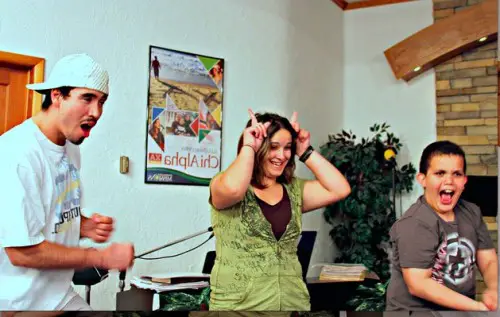
    Screaming Viking is a stationary/active/party game that is highly interactive and silly.  Players must correctly act out interesting things such as a “screaming viking,” a “chia pet,” “power rangers,” and other funny things.

    This game is good for children age 9 and up.  It’s an excellent game for parties and families.  The ideal number of players is about 12-15, making it a good medium and large group game.  No special materials are required to play.   You can play indoors or somewhere like a park.

    Screaming Viking

    Setup

    There is no special setup required for this game.  Have everyone sit in a large circle, with each person facing the middle.  The facilitator should teach everyone all the various motions for how to play.  More details will be given below.

    Instructions for Playing the Game

    The basic idea behind this game is simple: one person is in the middle and tries to get someone on the outside (seated within the circle) to make a mistake.  If a person makes a mistake, he or she becomes the new person in the middle.

    To get someone “out,” the person in the middle points to one person who is sitting on the outside and commands the action.  Typically, three people must then proceed to do a funny motion and make silly noises: the person who was pointed to, and the two people on the left and right, respectively.  The three people have ten seconds to do the action properly without making any mistakes.

    There are various actions that can be done.

    • the “Screaming Viking”: the person in the middle is the main viking, who forms two horns with their fingers on their forehead and screams loudly; the person to the left and right of that person must also make a fast rowing motion with their arms.
    • “Smurfs”: three people interlock their arms and sing the smurf song, “Laaa, la, la-la, la-la….”
    • “Chia Pet”:  One person in the middle is the plant, and the people to the left and right form the pot.  All three of them must sing loudly, “Ch-ch-ch-chia…”
    • “Jello”: the person selected in the middle must wobble like gelatin (jello), while the other two people form a bowl with their arms.

    The following video demonstrates how this game works:

    http://www.youtube.com/watch?v=ejV9BzjxZiY

    If a mistake is made by any of the three people (the person selected and the people to the left and right of that person) within ten seconds, that person must go into the middle to be “it.”

    Have fun!


  • Assa Party Game

    Assa (or Asa) is a Korean rhythm game that follows a pattern of saying “Assa [insert name]” and going back and forth between people, calling their sign/name.  There are many similar rhythm games that follow this kind of pattern as well.

    Setup for the Assa Party Game

    Everyone needs to prepare a two-syllable name (or something that can be said within two beats) and associated hand motion.  For example, a person’s call name could be “Su-per-man” or “Fly-ing Dra-gon” or just about anything, and their hand motion can be something that depicts their name (e.g. raising the right arm up like a flying superhero for Superman).  Each person needs a unique name and hand motion.  Before beginning the game, have everyone demonstrate their name and hand motion for the other players to learn.

    Playing Assa

    Like many rhythm games, the game follows a 4-beat count (1, 2, 3, 4, 1, 2, 3, 4, etc.).  On the 1 beat, everyone pats their legs, on the 2 beat, everyone claps their hands, on the 3 beat, everyone does a thumbs up with their left hand, and on the 4 beat, everyone does a thumbs up with their right hand.  The speed of the count can gradually get faster during the game.  One person (usually the loser of the previous round) begins the new round by setting the tempo (speed) of the 4-beat count.  Players must first say and do their name and motion, and then “pass” the motion to another player by saying their name and doing their hand motion.  This must be done correctly with perfect rhythm.   This process continues until someone makes a mistake.

    For example, let’s say there are 5 players playing the game:

    • Adam (who chooses the name “Flying Tiger” and a hand motion of a tiger paw clawing)
    • Bob (who chooses the name “Awesome Dancer” and a hand motion of doing a simple disco dance move)
    • Cathy (who chooses the name “I love pizza” and a hand motion of eating a pizza slice)
    • David (who chooses the name “Elephant” and a hand motion of  moving arms like an elephant trunk)
    • Evette (who chooses the name “Crazy Ninja” and a hand motion of a ninja stance)

    To begin, choose any player to start the round.  Everyone does the four beat motion (pat, clap, thumb, thumb) together and says the word “Aaaa…ssa” each time.  Bob begins the round by saying “Aaaa….ssa, Awe-some Dan-cer” (which fills up the four beat count).  The next four beats, Bob says, “Aaaa…sa, [name of another player].”  Thus, he can say, “Aaaa…sa, I-love-pizza.”  This passes the sign over to Cathy, who is “I-love-pizza.”

    Cathy must first do her sign (says “I-love-pizza” while doing her eating motion) and she he can pass the motion to any other player.

    A typical round may sound and look like this:

    All players: “Aaaa…saaa…”
    Bob: “Awe-some-dan-cer.” (first says and does his own sign)
    All players: “Aaaa…saaa..”
    Bob: “I-love-pizza” (calls out Cathy’s sign and does the eating motion)
    All players: “Aaaa…saaa..”
    Cathy: “I-love-pizza.” (says and does her own sign first)
    All players: “Aaaa…saaa..”
    Cathy: “Cray-zee-nin-ja..” (calls out Evette’s sign and the ninja motion)
    All players: “Aaaa…saaa..”
    Evette: “Cray-zee-nin-ja..” (says and does her own sign first)
    All players: “Aaaa…saaa..”
    Evette: [chooses any other player and their hand motion]

    This process keeps going until someone makes a mistake (wrong hand motion, missed timing, etc.).  The person who began the round can also increase speed if he or she likes. When a person makes a mistake, the round ends and that person begins the next round.


  • Ghost Game

    Ghost is a word game in which players try to add a letter to a growing word fragment — without ever actually spelling a word.  If they accidentally spell a valid word, they lose the round.  If they add a letter but a word is no longer possible to be made using those combination of letters, another player can “challenge” them.

    Ghost can be played with two or more players.  No materials are required, making it a convenient game for long car rides, etc.

    Setup for the Ghost Game

    There is no setup required.  Players must simply understand the rules of the game.

    Playing the Ghost Game

    The rules of ghost are relatively simple: each player takes turns adding a letter to an ever-growing word fragment.  Try not to spell a word (of length 4 letters or more).  Try to force another player to spell a word, or else try to get a player to say a letter that makes it impossible to form a word.

    Choose any player to start the game.  He or she may say any letter of the alphabet.  Each player then takes a turn to add a single letter to this fragment.  Instead of adding a letter, a player can “challenge” the last player who added a letter, if he or she thinks a word does not exist that starts with that fragment.  If a challenge occurs, the last player must try to say a word that begins with that fragment.  If the player who was challenged is able to spell a word, the challenger loses a point.   If the player who was challenged cannot spell a word, the challenger earns a point.  If a player accidentally spells a word, he or she also loses a point.  The round ends.

    After a round ends, play usually starts with the player who won the previous round.


  • King Elephant Game

    King Elephant (also known as Animal Kingdom Game) is well suited as a good party game or an icebreaker for meetings. It involves a little bit of silliness and is a lot of fun. The goal of the game is to become the King Elephant, the head of the circle.

    This active game works best if you have between 8 and 15 people. It is a good indoor game, and although it does require some movements (mainly making animal gestures), there is no running involved. No special props are required – it’s pretty simple to play! The recommended age is 10 and up.

    Setup for King Elephant Game

    Not much setup is required. Instruct all players to have a seat and arrange everyone in a circle, facing each other. Each seat in the circle will be a different animal, arranged in order from the top of the food chain (the King Elephant) down to the bottom of the food chain (a slimy worm). Designate one person to be the King Elephant and then assign the other animals in order. If you wish, you can let players choose their own animal and invent their own gesture for the animal. Otherwise, typical motions for the animals are:

    • King Elephant – hold one arm out, extended away from your nose, while the other arm wraps around and holds your nose.
    • Bird – join both of your thumbs together and flap your hands like a bird flying
    • Chicken – place your hands under armpits and flap your arms
    • Alligator – extend your arms out in front of you, with one hand facing up, and the other down, and clamp them both together like an alligator’s jaws
    • Bear – hold your two hands out like giant bear claws
    • Lion – connect your hands above your head like a circle, make a growling face like a lion’s roar
    • Snake – make a slithering snake movement with one of your arms
    • Fish – clasp both your hands together and imitate a fish swimming upstream
    • Monkey – puff cheeks, while pulling your ears out
    • Worm – wiggle one bent finger

    How to Play King Elephant

    King Elephant is a rhythm game in that you must successfully stay on beat. Depending on the chair you are currently seated in, each person adopts an animal gesture (as described above, or you may create a new one). The task is to correctly do your animal signal when called upon, and then to make another animal’s signal to try to get that person to make a mistake.

    The rhythm to maintain is set by the person who is King Elephant. He or she can alter the speed as desired. Everyone follows the rhythm of a 1-2-3-4 pattern, where 1 is a pat on the knee, 2 is a clap, 3 and 4 are left and right thumbs (or the signals). The person does his or her own signal (animal gesture and noise) first, followed by another animal’s signal. So for example, a round could look like this:

    King Elephant starts rhythm: knee pat, clap, elephant signal (his or her own signal),
    King Elephant signals a different player: knee pat, clap, bear signal (or anyone else’s signal),
    Bear continues: knee pat, clap, bear signal (his or her own signal),
    Bear signals another player: knee pat, clap, fish signal,
    Fish continues: knee pat, clap, fish signal (his or her own signal)..

    and so on. When people fail to keep the rhythm or make a mistake on their signal (e.g. do a signal when they aren’t supposed to) then they become the new worm and everyone else moves up by sliding up a seat. Those who change seats take on the role of a new animal. The goal is to try to be the King Elephant by knocking out anyone in front of you.

    Great fun! Be sure to get everyone to make funny animal sound effects when they do their signal too.

  • Tilt A Cup Game

    Build and hold onto an upright swinging tower of cups and balls. As the game progresses, this tower will become increasingly unwieldy, swinging unpredictably. You’ll have to use a steady hand to keep control of the tower.  Tilt that cup!  Catch the bouncing ping pong balls to win.

    This games uses elements of games like Moving On Up and Bouncer. You can play it as a solitaire challenge, as a competitive race, or in teams.

    You will need

    • 8 plastic cups per player
    • 8 ping pong balls per player

    Set up

    For each player:

    1. Put all cups together, one inside another, to create a compressed stack.
    2. The player takes hold of the stack of cups from the bottom.
    3. Put the 8 ping pong balls within easy reach.

    Rules

    Players create a tower of cups and balls by the following process:

    • They first bounce a ping pong ball on the ground, then catch that ping pong ball in their stack of cups.
    • When the ball is caught — the top cup in a stack now has a ping pong ball in it — the player takes the cup from the bottom of the stack and places it at the top. The new top cup is now sitting on a ping pong ball and has some freedom to move around.
    • Repeat this process. Bounce another ping pong ball and catch it in the top cup of the stack. Then move the bottom cup the top, adding to an increasingly wobbly tower of alternating cups and ping pong balls.

    Once a player has caught all ping pong balls, creating a tower where every cup is separated by a ping pong ball, with one final ping pong ball in the top cup, they have finished!

    This is a great game for challenging your coordination. You not only have to bound the ball with one hand and catch it using the cups in the other, but the top cup will get increasingly further away from the hand that it trying to keep it under control. If you move the tower of cups around too quickly, or hold it at the wrong angle, it might fall apart completely, forcing you to start again.

    Variants

    To play this as a race, simply give every player a stack and their own ping pong balls. The first player to finish the challenge wins!

    The team variant has one player taking control of the stack of cups and another starting with all the ping pong balls. The player with the balls will be standing several feet away and throwing the balls to the player holding the cups. All other rules are the same.

  • Psychiatrist Game

    Confuse the designated psychiatrist by acting like other people in the group.  The psychiatrist must guess who is who and why!

    This game works best for ages 13+.  It works great with medium to large sized groups of 6+ people.  Nothing is needed except a timer or stopwatch.  Indoors is the ideal setting.

    How to set up the Psychiatrist Game

    There is no required setup.  Players should be seated in a circle.  The “psychiatrist” will be in the center of the circle.

    How to play:

    1. Organize the group so that one person is chosen as the “psychiatrist” while the others are the “patients.” The psychiatrist can be a volunteer or selected based on criteria of your choice such as who has the nearest birthday.
    2. Have the psychiatrist leave the room and wait to be fetched by one of the patients or yourself. While they’re out of the room, the patients should all talk amongst themselves and discuss who is going to act like whom. This must be based on a specific pattern that will not change. For example: Patients can decide that they will each act like the person to their immediate left. No matter if they move around or switch places with each other, the pattern will stay the same.
    3. Bring the psychiatrist back into the room and line up the patients. Start the timer for a certain amount of time (recommended to be at least 5 minutes). The psychiatrist must question people and try to figure out who is acting like whom while the patients are acting like others based on their secret pattern. If the psychiatrist asks a question and the patient answers incorrectly, the person they are pretending to be must yell out “psychiatrist!” and everyone will get up and rearrange themselves.
    4. Even when everyone is rearranged, the pattern of who is acting like whom will stay the same. The game ends when the psychiatrist guesses the pattern correctly or when the designated time runs out. When the game is over the last person to have spoken to the psychiatrist will become the new psychiatrist if you are playing for another round.

    Winning the game

    If the psychiatrist can correctly guess the pattern that the patients came up with, they will be the winners of the game. If the time runs out and the psychiatrist cannot guess the pattern within the set amount of time than they will lose the game and the patients will be the winners.  Have fun!

  • Picture Whispers Game

    The Picture Whispers game is sort of like Pictionary mixed with the Telephone Game. Picture Whispers actually has some advantages over Pictionary. First, all players get to draw at the same time, and then get to guess at the same time, in phases, which means more game for everyone involved. Second, the game concludes with each player revealing sequentially all stage of drawings and guesses in their notepad, sharing with the group a short, absurd story of misunderstanding, non-sequitur, and debatable artistic merit. This reveal is similar in effect to — and has all the hilarity of — popular group storytelling game Consequences, or this collaborative drawing game.

    Play Picture Whispers with at least four players, and up to as many as you like, though as the game gets longer for every additional person in the chain, so if you have many more than ten it may be best to end the game after a certain number of passes (say, ten) rather than play all the way to the end of the circle. You could also split a large group into two smaller circles.

    Set-up:

    • All players sit in a circle, or around a table.
    • All players are given:
      • A small notebook or several small sheets of paper
      • A writing utensil.
      • Optional: Some item to be used as a bookmark, to mark which the current page is in case the notepad is closed, would also be useful.

    Rules:

    Each player will choose a word or phrase to write on the first page of their notebook. This could be an object, a person, a place, a concept, the title of a book or movie, or pretty much anything. Players are free to write something as sober, silly or lewd as they want — paying all respect to the company they are in, of course. Remember that some words are harder to express in pictures that others.

    Each player writes that word on the first page of their notebook, and passes their notebook to the player on their left. Be sure that nobody but the player on your left sees your notebook. Also be sure that nobody looks back through the notebook to see what was written or drawn by previous players.

    Now each player turns to the next page of their notebook, and draws an interpretation of the word they were passed. If the word on the first page of the notebook was “fairy”, you should now turn the page and draw a fairy, as best you can.

    Each player passes their notebook to the left again, looks at the drawing on the notebook they have just been passed from their right, and guesses what the word that inspired that drawing might be. Hopefully, the player who has just been passed a picture of a fairy writes “fairy”… but maybe that picture looks more like an “angel”, or “Tinkerbell”, or “Doctor Octopus”.

    Play proceeds in this manner, with every player alternately drawing a picture based on a work, or guessing a word based on a picture, until each notebook is passed back to its original owner (ie. the player that wrote the word on the first page).

    Now, in turn, each player reveals to the rest of the table, from the first page with the original word to the last used page, the contents of their notebook.

  • Rubber Chicken Game

    The Rubber Chicken Game is an active and fast paced game that is simple to play in any scenario. All the game requires is a rubber chicken—or any other object—and players! It’s great for those who are competitive and speedy. It requires all players to be attentive and ready to move at any given moment. The Rubber Chicken Game is best played outside or in large open areas, so that players can run around safely without crashing into anything. Groups of all sizes can play, but teams are better with between 5-10 players. Larger groups can play, but the overall game will take longer. Players are also able to steal the rubber chicken back from one another, but limits should be set to prevent injuries or excessive force.

    Set-Up and Materials

    • If the game is played outside, then check for any objects or holes that could cause injuries.
    • Assign one person to be the judge and give them a rubber chicken.
    • Take your players and split them into two even groups.
    • Set the groups parallel to each other and line each of them up.
    • Each line of players should be seated on the ground.

    How to Play the Rubber Chicken Game

    • Line each team up and have all of the players seated and facing the judge.
    • The judge will throw the rubber chicken wherever they choose behind all of the players.
    • On the judge’s command or whistle, the first seated player from each team will stand up and race to the chicken.
    • The players will then run back to their lines—the player with the rubber chicken should be protecting themselves, while the other player can try and steal the chicken back.
    • The player with the chicken will reach the line and toss the rubber chicken back strategically, so the next player on their team will have the advantage.
    • The next players from each team will run down again and race to the rubber chicken.
    • Both players will run back and sit down at the end of the line.
    • The game will continue until the whole line has run to retrieve the chicken.
    • Game Variations
    • The rubber chicken can be substituted for a ball, flag, doll, or any other object.
    • To make the game more challenging, you can set up obstacles that the players have to go through to retrieve the rubber chicken or to return back to their line—you can use a dizzy bat, hoops to jump through, cones to zigzag through, or other fun commands.
    • For additional challenges, you can also have players only use one arm to pick up the rubber chicken.
    • If the players are highly competitive or more physical, then they can use light force to take the rubber chicken from their opponent.
    • Boundaries can be set with paint or cones to keep the game area organized.
    • There can be more than two groups to increase the competition or groups can pair up with one another and battle each other.
  • Team Architect

    Team Architect is a game that requires both speed and precision. It’s a great way for players to unleash their creativity and work together towards a common goal. Team Architect is often played for team building or icebreaker purposes, but is entertaining enough to be played in any scenario. It’s best played with smaller groups, but there can be more than two groups playing at a time to increase the competition. Players of all ages will love this hands-on game.

    Team Architect simply requires each team to build something with a small amount of random materials. These materials aren’t usually useful and it’s not always clear how they can be used, which is why players have to get creative. For example, each team could be given Popsicle sticks and duct tape with the requirement to build a bridge that would hold a heavy book. Another example is giving each team string and newspaper, so they can make an egg support. The team’s creation must be able to support an egg when dropped from a specific height.


    Set-Up and Materials

    • Choose a designated area to play—inside or outside.
    • A timer—cell phone, egg timer, clock— is required and one person should be the designated timer to set reminders and countdowns.
    • Decide on the materials to be used in the game. They can be preselected or the players can just make use out of what objects are in the room.
    • For example, if you are playing this in an office, teams can use paper clips, tape, staplers, or any other objects found nearby.


    How to Play Team Architect

    • Sort out your groups—you can either have two small to medium-sized groups or multiple—three or four—small groups.
    • Assign a designated timer and the amount of time for the teams to craft their design.
    • Decide what each team will be building and what materials they can use.
      • For example, you will be building a tower out of marshmallows and toothpicks.
    • Set the timer and let the teams begin!
    • The first team who finishes or who has the better design that will be tested after the game can either determine the ending.
    • If testing the design, such as the egg drop example mentioned above, then the team who successfully protects the egg during the drop would win.
    • If there’s a tie, you can have a sudden death round where teams must add onto their creation or build a completely new object in a shorter amount of time.


    Game Variations

    • The overall goal can be adjusted, so teams can build a certain object—like a fort, build something functional—like a chair, or simply build the tallest building.
    • If playing outside, players can use natural objects like branches, leaves, or sand to build their creations.
    • Provide a shorter amount of time to increase competitiveness.
    • Teams could also be blindfolded during play for a real challenge while building or perhaps only use one hand each for building.
    • Teams can be in plain view of each other or hidden, so as not to copy the other team’s ideas.