Category: Rhythm

Rhythm games! These games usually involve a catchy rhythm and some timing that all players must follow. Stay on the beat and you will be fine. Coordination not required!

  • Screaming Viking Game

    Screaming Viking Game

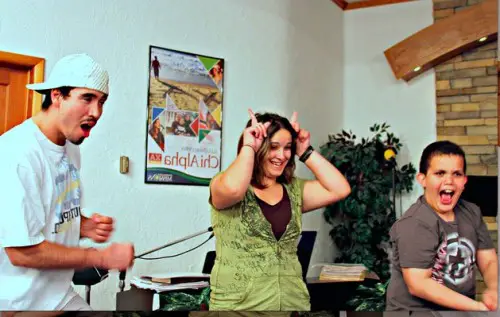
    Screaming Viking is a stationary/active/party game that is highly interactive and silly.  Players must correctly act out interesting things such as a “screaming viking,” a “chia pet,” “power rangers,” and other funny things.

    This game is good for children age 9 and up.  It’s an excellent game for parties and families.  The ideal number of players is about 12-15, making it a good medium and large group game.  No special materials are required to play.   You can play indoors or somewhere like a park.

    Screaming Viking

    Setup

    There is no special setup required for this game.  Have everyone sit in a large circle, with each person facing the middle.  The facilitator should teach everyone all the various motions for how to play.  More details will be given below.

    Instructions for Playing the Game

    The basic idea behind this game is simple: one person is in the middle and tries to get someone on the outside (seated within the circle) to make a mistake.  If a person makes a mistake, he or she becomes the new person in the middle.

    To get someone “out,” the person in the middle points to one person who is sitting on the outside and commands the action.  Typically, three people must then proceed to do a funny motion and make silly noises: the person who was pointed to, and the two people on the left and right, respectively.  The three people have ten seconds to do the action properly without making any mistakes.

    There are various actions that can be done.

    • the “Screaming Viking”: the person in the middle is the main viking, who forms two horns with their fingers on their forehead and screams loudly; the person to the left and right of that person must also make a fast rowing motion with their arms.
    • “Smurfs”: three people interlock their arms and sing the smurf song, “Laaa, la, la-la, la-la….”
    • “Chia Pet”:  One person in the middle is the plant, and the people to the left and right form the pot.  All three of them must sing loudly, “Ch-ch-ch-chia…”
    • “Jello”: the person selected in the middle must wobble like gelatin (jello), while the other two people form a bowl with their arms.

    The following video demonstrates how this game works:

    http://www.youtube.com/watch?v=ejV9BzjxZiY

    If a mistake is made by any of the three people (the person selected and the people to the left and right of that person) within ten seconds, that person must go into the middle to be “it.”

    Have fun!


  • Assa Party Game

    Assa (or Asa) is a Korean rhythm game that follows a pattern of saying “Assa [insert name]” and going back and forth between people, calling their sign/name.  There are many similar rhythm games that follow this kind of pattern as well.

    Setup for the Assa Party Game

    Everyone needs to prepare a two-syllable name (or something that can be said within two beats) and associated hand motion.  For example, a person’s call name could be “Su-per-man” or “Fly-ing Dra-gon” or just about anything, and their hand motion can be something that depicts their name (e.g. raising the right arm up like a flying superhero for Superman).  Each person needs a unique name and hand motion.  Before beginning the game, have everyone demonstrate their name and hand motion for the other players to learn.

    Playing Assa

    Like many rhythm games, the game follows a 4-beat count (1, 2, 3, 4, 1, 2, 3, 4, etc.).  On the 1 beat, everyone pats their legs, on the 2 beat, everyone claps their hands, on the 3 beat, everyone does a thumbs up with their left hand, and on the 4 beat, everyone does a thumbs up with their right hand.  The speed of the count can gradually get faster during the game.  One person (usually the loser of the previous round) begins the new round by setting the tempo (speed) of the 4-beat count.  Players must first say and do their name and motion, and then “pass” the motion to another player by saying their name and doing their hand motion.  This must be done correctly with perfect rhythm.   This process continues until someone makes a mistake.

    For example, let’s say there are 5 players playing the game:

    • Adam (who chooses the name “Flying Tiger” and a hand motion of a tiger paw clawing)
    • Bob (who chooses the name “Awesome Dancer” and a hand motion of doing a simple disco dance move)
    • Cathy (who chooses the name “I love pizza” and a hand motion of eating a pizza slice)
    • David (who chooses the name “Elephant” and a hand motion of  moving arms like an elephant trunk)
    • Evette (who chooses the name “Crazy Ninja” and a hand motion of a ninja stance)

    To begin, choose any player to start the round.  Everyone does the four beat motion (pat, clap, thumb, thumb) together and says the word “Aaaa…ssa” each time.  Bob begins the round by saying “Aaaa….ssa, Awe-some Dan-cer” (which fills up the four beat count).  The next four beats, Bob says, “Aaaa…sa, [name of another player].”  Thus, he can say, “Aaaa…sa, I-love-pizza.”  This passes the sign over to Cathy, who is “I-love-pizza.”

    Cathy must first do her sign (says “I-love-pizza” while doing her eating motion) and she he can pass the motion to any other player.

    A typical round may sound and look like this:

    All players: “Aaaa…saaa…”
    Bob: “Awe-some-dan-cer.” (first says and does his own sign)
    All players: “Aaaa…saaa..”
    Bob: “I-love-pizza” (calls out Cathy’s sign and does the eating motion)
    All players: “Aaaa…saaa..”
    Cathy: “I-love-pizza.” (says and does her own sign first)
    All players: “Aaaa…saaa..”
    Cathy: “Cray-zee-nin-ja..” (calls out Evette’s sign and the ninja motion)
    All players: “Aaaa…saaa..”
    Evette: “Cray-zee-nin-ja..” (says and does her own sign first)
    All players: “Aaaa…saaa..”
    Evette: [chooses any other player and their hand motion]

    This process keeps going until someone makes a mistake (wrong hand motion, missed timing, etc.).  The person who began the round can also increase speed if he or she likes. When a person makes a mistake, the round ends and that person begins the next round.


  • King Elephant Game

    King Elephant (also known as Animal Kingdom Game) is well suited as a good party game or an icebreaker for meetings. It involves a little bit of silliness and is a lot of fun. The goal of the game is to become the King Elephant, the head of the circle.

    This active game works best if you have between 8 and 15 people. It is a good indoor game, and although it does require some movements (mainly making animal gestures), there is no running involved. No special props are required – it’s pretty simple to play! The recommended age is 10 and up.

    Setup for King Elephant Game

    Not much setup is required. Instruct all players to have a seat and arrange everyone in a circle, facing each other. Each seat in the circle will be a different animal, arranged in order from the top of the food chain (the King Elephant) down to the bottom of the food chain (a slimy worm). Designate one person to be the King Elephant and then assign the other animals in order. If you wish, you can let players choose their own animal and invent their own gesture for the animal. Otherwise, typical motions for the animals are:

    • King Elephant – hold one arm out, extended away from your nose, while the other arm wraps around and holds your nose.
    • Bird – join both of your thumbs together and flap your hands like a bird flying
    • Chicken – place your hands under armpits and flap your arms
    • Alligator – extend your arms out in front of you, with one hand facing up, and the other down, and clamp them both together like an alligator’s jaws
    • Bear – hold your two hands out like giant bear claws
    • Lion – connect your hands above your head like a circle, make a growling face like a lion’s roar
    • Snake – make a slithering snake movement with one of your arms
    • Fish – clasp both your hands together and imitate a fish swimming upstream
    • Monkey – puff cheeks, while pulling your ears out
    • Worm – wiggle one bent finger

    How to Play King Elephant

    King Elephant is a rhythm game in that you must successfully stay on beat. Depending on the chair you are currently seated in, each person adopts an animal gesture (as described above, or you may create a new one). The task is to correctly do your animal signal when called upon, and then to make another animal’s signal to try to get that person to make a mistake.

    The rhythm to maintain is set by the person who is King Elephant. He or she can alter the speed as desired. Everyone follows the rhythm of a 1-2-3-4 pattern, where 1 is a pat on the knee, 2 is a clap, 3 and 4 are left and right thumbs (or the signals). The person does his or her own signal (animal gesture and noise) first, followed by another animal’s signal. So for example, a round could look like this:

    King Elephant starts rhythm: knee pat, clap, elephant signal (his or her own signal),
    King Elephant signals a different player: knee pat, clap, bear signal (or anyone else’s signal),
    Bear continues: knee pat, clap, bear signal (his or her own signal),
    Bear signals another player: knee pat, clap, fish signal,
    Fish continues: knee pat, clap, fish signal (his or her own signal)..

    and so on. When people fail to keep the rhythm or make a mistake on their signal (e.g. do a signal when they aren’t supposed to) then they become the new worm and everyone else moves up by sliding up a seat. Those who change seats take on the role of a new animal. The goal is to try to be the King Elephant by knocking out anyone in front of you.

    Great fun! Be sure to get everyone to make funny animal sound effects when they do their signal too.

  • The Priest of the Parish

    The Priest of the Parish is a call and response game, popular in youth groups across the world.  The game warms up player’s vocal cords, legs, and memory muscles.  It also goes by other names, including The Prince of Paris.

    This version of the game can be played with very large groups, even over one hundred (arranged into teams).  It can also be played individually with groups of ten or so. In both games the players must remember the script. One of the goals is to speak in unison with your team-members, fostering a sense of team spirit.

    Set-up

    1. Arrange the players into teams. There should be an equal number of teams. Five to ten players is a good team size. For example, six teams of five would work for thirty players, and for one hundred players pick ten teams of ten.
    2. Have all players stand in their teams in two rows a few meters apart, facing each other, so that each team faces another team.
    3. Give each team a number or name.

    The script

    • The organizer starts the round by stating:
      “The priest of the parish has lost his thinking cap. Some say this, and some say that, but I say it was Team [X].” (where [X] is one of the team names).
    • The announced team stands up, and that team and the organizer now follow this script:

    Team: “Who me sir?”
    Organizer: Yes you, sir.
    Team: Couldn’t be, sir.
    Organizer: Then who, sir?
    Team: Team [X], sir.
    Organizer: Team [X]?

    The newly team accused now has the same conversation with the organizer, and so on.

    • If a team speaks out of unison, fails to stand up, or if a team stands up when they should not have, that team is moves to one end of their row, and the other teams in their row move up to fill the gap.

    The goal of the game is to be as far from the “loser’s end” of the rows as possible — though don’t take this goal too seriously. The game is really about getting everyone speaking up, rushing and getting excited, making mistakes, and having a few laughs.

    Variations

    Many variations can change the dynamic of this game in interesting ways.

    If playing with individuals, you don’t need to gives numbers, but can just refer to everyone by name. This makes it a nice introductions game, as everyone must remember each other’s names.

    The script can become more complex, making it harder to remember and therefore easier to make mistakes. This is great when playing as individuals, instead of in teams, as the challenge of remembering the script and not getting tongue tied replaces the challenge of speaking in unison. One such more complex script that has been observed includes the following line in place of saying “Team [X], sir”:

    “I [player name], with an honorable flick to the front, do hereby accuse [another team or player]”. The player would additional salute as they say “an honorable flick to the front”. Failing to recite the accusation exactly prompted raucous cries of “Objection!” from the other players.

    Another variation, when playing in teams, would be to have the names or numbers assigned to the positions in the row, not the teams themselves. For instance, the third team in the row would start the game as team 3, but if they make a mistake and moved down the row they would become team 1, and two other teams would move up and their numbers would also change. The new challenge here is just to remember what your number is, and everyone will find great amusement watching the odd player jump up when it isn’t their turn because they forgot their number. Or when almost everyone in a team jumps up, but leaves one inattentive player sitting!

  • Zip, Zap, Boing

    A quick thinking game like Hot Potato without a ball. Kids play it on the playground, drama students play it as a warm-up exercise, and party-goers play it as a drinking game.This versatile little distraction has many variations, each named differently after the words called. Most start with Zip; Zip Zap Zop, for example. The hard to pronounce Zoom Schwartz Profigliano is a related game.

    Both of the versions described below are best played with groups of about ten or more.

    Zip Zap Zop

    This most basic version of them game isn’t very challenging, but will get a group moving and using their voice, and get them used to paying attention and responding. It’s great for the start of a class!

    Set-Up

    Everyone stands in a circle.

    Rules

    1. The first player claps their hands, says “Zip”, and points at another player in the circle.
    2. The player that was pointed to must immediately clap and point at someone else in the circle (including the previous player), saying “Zap”.
    3. The third player continues the pattern, this time using the word “Zop”.
    4. The pattern of words repeats, going: “Zip”, “Zap”, Zop”, “Zip”, “Zap” etc.
    5. If anyone hesitates or says the wrong word, they take a strike.
    6. Three strikes and a player loses, which ends the round.
    7. Try to play the game with some speed to increase the chances of a mistake.


    Zip Zap Boing

    This variation ups the difficulty. Instead of going through the words in a predetermined order, the player’s choose which word to use, and each has a different effect. Here is one way to play it:

    Rules

    • If a player wants to choose the player to their left, they point and say Zip.
    • If they want to choose the player on their right, the point and say Zap.
    • If they want to choose the person that just pointed at them, they say Boing without pointing.
    • Each time another player is selected in this way, it is their turn to quickly Zip, Zap, or Boing.
    • If a player hesitates or doesn’t respond when it is their turn, they get a strike. If a player’s word doesn’t match where they are pointing, they get a strike. The first player to three strikes loses, and the game ends.

    After a round or two, mix things around and up the confusion by changing the rules: now, when a player Zips or Zaps, they DON’T point, and when the Boing, they DO point. Everyone’s brain will get twisted into knots trying to relearn when to point and when not to, and the players to either side of the current player will have to be really paying attention because they have to rely on the words rather than the motions to know when it is their turn.

  • Gone Fishin’

    Gone Fishin is a group game based on its board game counterpart of the same name. In this game, you will need to be the player who catches the most fish in order to win. This game will work best with large to extra large groups and will require players to switch roles frequently. This game may best be played at an event or party where space will be accessible.

    Materials Needed

    You will need to gather a few materials for this game  to make it work.  Materials needed to play Gone Fishin’:

    • Poles or sticks
    • String
    • A music player
    • A few rhythmic songs
    • A large area
    • Tape (optional)

    How To Set Up The Game

    First, start by picking a big open space that plenty of people can fit into; you’re going to need a lot of room to really make this work. Next, you need to create four fishing rods using the string and sticks, make sure that the string is tightly attached and won’t fall off when pulled on. Depending on the general height of your participants make the string long enough to reach from their waste to the floor. Finally, pick a song with a steady beat. It may help to put markers or tape x’s on the floor if your fish are younger so they know where to sit and fill in.

    *Make sure to have multiple songs on stand-by to change things up each round!

    How To Play Gone Fishin’

    Gather everyone together in a tight circle and pick four players to be the fishers. The rest of the players are going to be the fish for the game and you can rotate out these rolls as you go. Instruct the fish to open and close their hand to the beat of the music playing. The fishers have to get the string safely into the fish’s hands in order to score a point. When a player catches a fish the fish will then join them on their side of the room. The game will end when the song ends or when all the fish are caught.Lastly, the player can get as close to the fish as safely possible, but can not touch the string in any way other than indirect contact through the fishing pole.

    * Hard mode: Assign colors to the player and the fish. The player can now only catch a fish of the same color as theirs and can only win by catching all of their fish. For this version of the game, you may want to get the player to rotate occasionally throughout the song.

    How To Win

    Listen to the beat of the music and get your movements in sync. Pay attention to the players that are most in sync as well these will be the easiest fish to hook. If you are feeling to pushed you may not get many fish; relax and only throw your line in when you feel confident you will catch something. If you are matching colors be sure to visualize where all the players you need to catch are before you start casting your line.