Category: Extra Large Group

Extra Large Group Icebreakers. Got a huge group of 30 or more people? No sweat. Try these activities!

  • Icebreaker Questions

    Icebreaker Questions is our list of over 20 great questions that you can ask people to help them feel more included — part of a group or team.  These questions are fun and non-threatening. You can use them as an icebreaker activity for meetings or classrooms, written on notecards and adapted for other games, or simply as a fun activity to help people get to know each other better. These are actually a great way to build initial trust and eventually even intimacy — for example, on a first date!

    Instructions for Icebreaker Questions

    A great way to help people open up is to ask them fun questions that allow them to express their personality or interesting things about them.  Here is a list of twenty safe, useful icebreaker questions to help break the ice:

    1. If you could have an endless supply of any food, what would you get?
    2. If you were an animal, what would you be and why?
    3. What is one goal you’d like to accomplish during your lifetime?
    4. When you were little, who was your favorite super hero and why?
    5. Who is your hero? (a parent, a celebrity, an influential person in one’s life)
    6. What’s your favorite thing to do in the summer?
    7. If they made a movie of your life, what would it be about and which actor would you want to play you?
    8. If you were an ice cream flavor, which one would you be and why?
    9. What’s your favorite cartoon character, and why?
    10.  If you could visit any place in the world, where would you choose to go and why
    11. What’s the ideal dream job for you?
    12. Are you a morning or night person?
    13. What are your favorite hobbies?
    14. What are your pet peeves or interesting things about you that you dislike?
    15. What’s the weirdest thing you’ve ever eaten?
    16. Name one of your favorite things about someone in your family.
    17. Tell us about a unique or quirky habit of yours.
    18. If you had to describe yourself using three words, it would be…
    19. If someone made a movie of your life would it be a drama, a comedy, a romantic-comedy, action film, or science fiction?
    20. If I could be anybody besides myself, I would be…

    Also check out How Do You Play for Icebreaker Questions. Or, for sillier and more hilarious questions, check out our Funny Icebreaker Questions.

  • Assa Party Game

    Assa (or Asa) is a Korean rhythm game that follows a pattern of saying “Assa [insert name]” and going back and forth between people, calling their sign/name.  There are many similar rhythm games that follow this kind of pattern as well.

    Setup for the Assa Party Game

    Everyone needs to prepare a two-syllable name (or something that can be said within two beats) and associated hand motion.  For example, a person’s call name could be “Su-per-man” or “Fly-ing Dra-gon” or just about anything, and their hand motion can be something that depicts their name (e.g. raising the right arm up like a flying superhero for Superman).  Each person needs a unique name and hand motion.  Before beginning the game, have everyone demonstrate their name and hand motion for the other players to learn.

    Playing Assa

    Like many rhythm games, the game follows a 4-beat count (1, 2, 3, 4, 1, 2, 3, 4, etc.).  On the 1 beat, everyone pats their legs, on the 2 beat, everyone claps their hands, on the 3 beat, everyone does a thumbs up with their left hand, and on the 4 beat, everyone does a thumbs up with their right hand.  The speed of the count can gradually get faster during the game.  One person (usually the loser of the previous round) begins the new round by setting the tempo (speed) of the 4-beat count.  Players must first say and do their name and motion, and then “pass” the motion to another player by saying their name and doing their hand motion.  This must be done correctly with perfect rhythm.   This process continues until someone makes a mistake.

    For example, let’s say there are 5 players playing the game:

    • Adam (who chooses the name “Flying Tiger” and a hand motion of a tiger paw clawing)
    • Bob (who chooses the name “Awesome Dancer” and a hand motion of doing a simple disco dance move)
    • Cathy (who chooses the name “I love pizza” and a hand motion of eating a pizza slice)
    • David (who chooses the name “Elephant” and a hand motion of  moving arms like an elephant trunk)
    • Evette (who chooses the name “Crazy Ninja” and a hand motion of a ninja stance)

    To begin, choose any player to start the round.  Everyone does the four beat motion (pat, clap, thumb, thumb) together and says the word “Aaaa…ssa” each time.  Bob begins the round by saying “Aaaa….ssa, Awe-some Dan-cer” (which fills up the four beat count).  The next four beats, Bob says, “Aaaa…sa, [name of another player].”  Thus, he can say, “Aaaa…sa, I-love-pizza.”  This passes the sign over to Cathy, who is “I-love-pizza.”

    Cathy must first do her sign (says “I-love-pizza” while doing her eating motion) and she he can pass the motion to any other player.

    A typical round may sound and look like this:

    All players: “Aaaa…saaa…”
    Bob: “Awe-some-dan-cer.” (first says and does his own sign)
    All players: “Aaaa…saaa..”
    Bob: “I-love-pizza” (calls out Cathy’s sign and does the eating motion)
    All players: “Aaaa…saaa..”
    Cathy: “I-love-pizza.” (says and does her own sign first)
    All players: “Aaaa…saaa..”
    Cathy: “Cray-zee-nin-ja..” (calls out Evette’s sign and the ninja motion)
    All players: “Aaaa…saaa..”
    Evette: “Cray-zee-nin-ja..” (says and does her own sign first)
    All players: “Aaaa…saaa..”
    Evette: [chooses any other player and their hand motion]

    This process keeps going until someone makes a mistake (wrong hand motion, missed timing, etc.).  The person who began the round can also increase speed if he or she likes. When a person makes a mistake, the round ends and that person begins the next round.


  • Story Starters Activity

    Story Starters is a good get-to-know-you icebreaker to help people share interesting stories about themselves.  It works in groups of all sizes.  For very large groups, simply have everyone split into smaller groups of 4-6 people.

    Setup for Story Starters

    Setup of this icebreaker is flexible.  Materials required: Oxford 5″x8″ notecards and plenty of ballpoint pens.

    The facilitator can prepare cards in advance, or the following could be written on a chalkboard/whiteboard/Powerpoint slide.

    Write the following sentences, one on each card:

    • “Once upon a time, I…”
    • “My favorite place I ever went to is…”
    • “The silliest thing I ever did was…”
    • “My ideal vacation is…”
    • “The craziest thing I ever did (that I’ll admit to) is…”
    • “If my life were a book, I would title it…”

    You can also come up with many more.

    Distribute these cards to each group (or show these on a chalkboard/whiteboard/Powerpoint on the front of the room).  Within each small group, each group member must choose one Story Starter and begin a story using one of these sentences as a starting point.

    Each group can vote on which story is the most interesting.  The most interesting stories can be shared to the larger group.

    Buy the materials for Story Starters at our online store, powered by Amazon.

  • Blanket Game

    Blanket Game

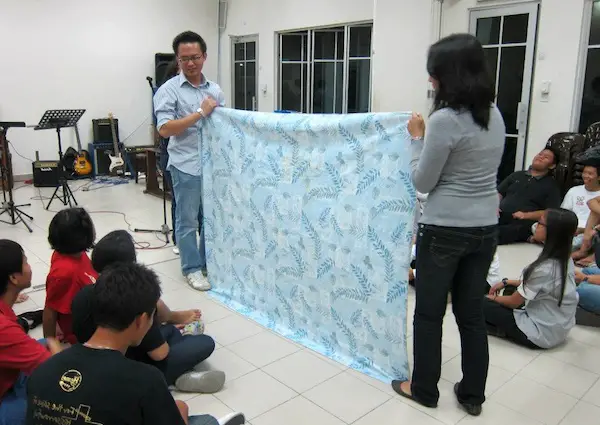
    The Blanket Game is a funny icebreaker to get to know other folks in the room.  A large blanket is held up between two groups, and one player from each team stands behind the blanket.  The goal of the game is to be the first to identify the other person behind the blanket.

    Materials required: One very large blanket (or curtain).

    This game works for small, medium, and large groups, although teams of 10 people probably work best.  For extremely large groups, pick about 20 volunteers to go to the front of the room to play.

    Setup for the Blanket Game

    There is not much setup involved for this activity.  Form two large teams, preferably about 5-10 people per team.  Have each team go to the front of the room.  Have two volunteers hold a blanket or curtain open between the two groups, so that each group cannot see behind the blanket.  If players do not know each other well, quickly have each player introduce their name to the room.

    Playing the Blanket Game

    blanket-game

    For each turn, each team chooses a volunteer to stand (or sit) behind the blanket.  The facilitator will count “1, 2, 3” and then drop the blanket.  The first player to correctly identify the name of the other player wins the round, earning one point.

    Repeat until one team reaches a desired number of points (or whenever time runs out).  This activity is a good way to learn names.  Have fun!

    To get supplies for the Blanket Name Game, shop our online store.

  • Candy Introductions Activity

    Candy Introductions Activity is a get-to-know-you game that helps people learn new facts about each other in an easy way.  They select various pieces of candy from a bag, and each candy variety is associated with a fact about themselves which they will introduce to the others. This game also goes by other names, including the M&M game, Candy Confessions, the Skittles Game, the Gum Drop game, among others.

    Candy Introductions can work with any group size.  The icebreaker game works best when the group size is limited to 12, so if you have more than 12, divide the larger group and run the icebreaker within the smaller sized groups.  This icebreaker works best indoors, and is well suited for classrooms or meeting rooms.  Materials required are: candy with about five different variations (color or candy type), and an optional chalkboard/whiteboard.

    Setup for Candy Introductions

    Purchase several variety packs of candy, enough for each person to be able to have at least five pieces.  They can be any candy type, but not too many choices (limit it to around five or six different varieties).  Alternatively, you can buy gummy bears, life savers, gum drops, skittles, m&ms, or any other candy that already has a variety of colors.

    Instructions for How to Play 

    Pass around the candy and tell each participant to choose anywhere from 1 to 5 pieces of anything that they want.  Instruct them not to eat it yet, though.  After they have chosen their candy, you will tell them what each candy type/color represents.

    If there is a whiteboard or chalkboard present, write on the board the following:

    • Red – Favorite hobbies
    • Green – Favorite place on earth
    • Blue – Favorite memory
    • Yellow -Dream job
    • Orange – Wildcard (tell us anything about yourself!)

    If you don’t have the above colors, change the above to match the candy types that you have.  Each person takes turns introducing himself or herself, beginning with their name and then saying one fact for each candy type that they have.  This easy introduction game should go relatively quickly (assuming they weren’t greedy and that they didn’t take too many pieces of candy!)

  • Fabulous Flags Game

    Fabulous Flags (also known as the Personal Flags Game) is a useful icebreaker activity to help people convey what represents them or what is important to them.  Each person draws a flag that contains some symbols or objects that symbolizes who they are or what they enjoy.

    This get-to-know-you activity is best done indoors.  Any number of people can participate.  The recommended age is 7 and up.  Materials required are: several sheets of paper, pens, and colored pencils/crayons/markers.

    Instructions for Fabulous Flags Activity

    Pass out a sheet of paper, pens, and colored pencils, crayons, and/or markers to each person.  Explain the activity: “We’re now going to draw flags that represent or symbolize us.  Please design your own flag of you – include some symbols or objects that symbolize who you are or what you find enjoyable or important.”  You can show your own sample flag if you like.  For example, you could draw:

    • a guitar (representing your passion for music)
    • a tennis racket (someone who enjoys sports)
    • a country like India (representing your affiliation with a country)
    • a cross and a heart (representing Jesus and His love for the world)

    Give everyone a set amount of time to draw (e.g. 15-20 minutes or so) and then reconvene.  Ask for volunteers to share their flags and explain the meaning of what they drew.  If it is a large group, you can divide everyone into smaller groups and ask them to share their flags with each other, or you can just ask a small number of volunteers to share.

    Variations

    After everyone has finished sharing the individual flags, as a big group you can ask everyone to brainstorm ideas on what to draw for a large class-wide flag.  Proceed to delegate individuals to draw certain parts of the class-wide flag.  Alternatively, you can collect the individual flags and paste them onto a board to create a “quilt” of individual flags, representing unity.

    (credits: thanks Eunice!)

  • 3 Icebreaker Games That Use Drink Cans

    1. Tipsy

    Here’s a cool party trick: if you leave just the right amount of liquid in a tin can, you can balance that can diagonally, on its edge. We’re use that fact to play a quick relay race, one part drinking game and one part balancing act.

    You will need

    One unopened 330 ml drink can for each player.
    Tables or other surface in reach of all players. This is so they have somewhere to balance their drink.

    Set-Up

    1. Split the room into two teams.
    2. Have each team arranged into a rough line, so they know what order they will play in.
    3. Give all players an unopened drink.
    4. For both teams tell the players at one end of the line that they will be the starting players.

    Rules

    The starting players open their can, drink approximately three quarters of the contents, and then attempt to balance the can on it’s edge, as quickly as they can.

    As soon as a player has successfully balanced their can, the next player in their team can proceed to open their own can and attempt the challenge. This makes this game into a sort of relay race.

    The first team to get from the start of their line to the end, with the last player having successfully balanced their can wins!

    Now that you’ve got lot’s of empty cans, we can use them for the following games!:

    2. Sliding Towers

    Do you think you could slide an empty can across a table… using only your head? Race others for the title of fastest moving face.

    You will need

    • Six empty cans per player.
      Your noggin.
      An empty table.

    Set-up

    Place an empty can near the corner of the table. If two people play simultaneously, also put a can in the opposite corner. Each player will start in one of these corners.
    Nearby, but out of the way, place the other cans so you have stacks of two and stacks of three.

    Rules

    Each player must push the single can from their end of the table to the other end using only their head and face. They cannot touch the can with their hands, shoulders neck etc. or they must take the can back to the starting position and try again.

    When a player has successfully pushed their can to end of the table, they immediately pick up a stack of two cans, put them in their starting corner, and go again with the larger stack.

    After the stack of two, players progress onto the stack of three. If at any time the stack falls over, it is immediately moved back to the starting position and the player can try again.

    This game is a race! The first player to get the third stack of cans to the end of the table wins.

    3. Candelier

    Become an architect of dangerous structures in this game, where you build a large, structurally unsound inverse pyramid out of cans and paper plates.

    You will need

    • 15 Empty Cans Per player
      5 Paper Plates per player

    (If you don’t have enough cans to play with multiple players at the same time, do this game one player at a time, and time the results. The fastest player wins)

    Set-up

    Put the cans and paper plates in reach of the players.

    Rules

    • The challenge is to build the following structure:
      One can as the foundation.
      A paper plate on top of each level of cans.
      One extra can per level of top of the plates.
      Until you end with five cans on the top level, and a final plate on top.
      This creates a sort of wonky pyramid shape, with increasing numbers of cans alternating with paper plates.

    The structure may topple, but the players can always continue on from whatever is left. The first player to finish their “candelier” wins!

  • Newspaper Towers Game

    Compete against other teams to see who can build the largest tower using only one ingredient – newspaper!  Newspaper Towers (also known as Build the Tower) is a great teambuilding activity involves creativity, coordination, and teamwork!

    This activity works best for people ages 8 and up.  It works great for groups of six to fifteen people.

    Materials needed

    • A lot of newspapers — be sure to recycle them!
    • A timer or stopwatch
    • Rolls of scotch tape
    • Measuring tape

    How to set up Newspaper Towers

    Collect as many newspapers as possible in advance and separate them into equal piles. If you know how many people will be there, create 1 pile for each team you will have, but if you don’t know the group size just create equal piles of newspapers with some left over as spares.

    How to play Newspaper Towers

    1. Divide the main group up into teams. Ideal size for each team is between 2 – 4 people. If you are doing this as a team-building exercise, you might consider larger teams to promote healthy communication and interactions, otherwise 4 should be your maximum group size.
    2. Give each group an equal pile of newspaper and a roll of tape. Ensure that you have some spare newspapers in case one team ends up needing them for any reason.
    3. Set your timer for around 5-10 minutes or prepare your stopwatch. On your signal, all teams should go to their newspaper piles and begin working. The goal of the game is to build the largest tower out of only newspapers. Teams can use any sort of design methods they would like as long as only the newspaper is being used and no assistance is given by glue, tape, staples, or anything else.
    4. Once the designated amount of time expires, all teams must immediately stop working on their towers – and hope they stay up! Go around and inspect the towers, being sure to measure each tower to find out which one is the tallest of them all. Also check that only newspaper was used with no other supplies. Any tower that falls over before its height is judged cannot be repaired or built again.

    Winning the game

    The winner of this game is the team that successfully builds the tallest tower using only newspaper and tape. Any tower design is acceptable as well as any building method, as long as the teams are only using the provided supplies of newspaper.  For a harder game, use less (or no) tape.

    Alternatively, you could judge based on a point system that give credit for artistic designs and creativity as well as the height of the tower.

  • Extreme Rock, Paper, Scissors Game

    Battle it out to see who is the rock, paper, scissors champion of the group — as the losers of each mini-round cheer the remaining winners on!

    This game works best for ages 12 and up.  It’s recommended for large or extra large groups of 15+ people.

    Setup for Extreme Rock, Paper, Scissors

    No special materials are required to play this game, making it convenient and free to play.

    How to play Extreme Rock, Paper, Scissors

    1. Have each member of the group pair up for the first round of rock, paper, scissors. If there is an odd number, add the odd person out to another pair and have them do a quick knock-out match to form a pair. Alternatively, you can ask for a volunteer to participate as a referee with you.
    2. Everyone should be in pairs. Ask them to play 3 games, and the best 2 out of 3 will be the winner. You should act as a referee during this time in case there are any disputes or confusions.
    3. Instruct the losers of the first match to start cheering the name of the person who beat them and following that person around to their next game.
    4. Have all the winners pair up and face off against each other while the ones they beat are cheering for them. When one winner beats the other, all the people behind the losing player should start cheering for the winning player.
    5. Repeat this process in elimination, tournament style, until there are only two players left. Each should have a large group of people cheering them on from their previous wins. Let them play the final match. The game is over after one player wins the final match.
    6. (Optional): If you have an odd number of people and you want to reset the game and play again, have the winner of the last game stand aside as a referee with you to give another player the chance to win instead.

    Winning the game:

    The last person standing in this tournament is the winner. They must not lose against any player from the beginning to the end of the game. At the end, the winning player should have all the other players cheering for them. A small prize can be awarded to the winner if you choose, otherwise you can reset the game and play again.

  • Psychiatrist Game

    Confuse the designated psychiatrist by acting like other people in the group.  The psychiatrist must guess who is who and why!

    This game works best for ages 13+.  It works great with medium to large sized groups of 6+ people.  Nothing is needed except a timer or stopwatch.  Indoors is the ideal setting.

    How to set up the Psychiatrist Game

    There is no required setup.  Players should be seated in a circle.  The “psychiatrist” will be in the center of the circle.

    How to play:

    1. Organize the group so that one person is chosen as the “psychiatrist” while the others are the “patients.” The psychiatrist can be a volunteer or selected based on criteria of your choice such as who has the nearest birthday.
    2. Have the psychiatrist leave the room and wait to be fetched by one of the patients or yourself. While they’re out of the room, the patients should all talk amongst themselves and discuss who is going to act like whom. This must be based on a specific pattern that will not change. For example: Patients can decide that they will each act like the person to their immediate left. No matter if they move around or switch places with each other, the pattern will stay the same.
    3. Bring the psychiatrist back into the room and line up the patients. Start the timer for a certain amount of time (recommended to be at least 5 minutes). The psychiatrist must question people and try to figure out who is acting like whom while the patients are acting like others based on their secret pattern. If the psychiatrist asks a question and the patient answers incorrectly, the person they are pretending to be must yell out “psychiatrist!” and everyone will get up and rearrange themselves.
    4. Even when everyone is rearranged, the pattern of who is acting like whom will stay the same. The game ends when the psychiatrist guesses the pattern correctly or when the designated time runs out. When the game is over the last person to have spoken to the psychiatrist will become the new psychiatrist if you are playing for another round.

    Winning the game

    If the psychiatrist can correctly guess the pattern that the patients came up with, they will be the winners of the game. If the time runs out and the psychiatrist cannot guess the pattern within the set amount of time than they will lose the game and the patients will be the winners.  Have fun!