Category: Get-to-know-you

Get-to-know-you games. These icebreakers help people get to know each other better! When people don’t know each other well, a good icebreaker can be extremely useful. These activities can quickly help people get to know each others’ names and to go deeper — how do people think? What are their interests? What are their goals and deeper desires? Try these activities for the first day of class or whenever you are in a situation where you want to get to know someone better.

  • Icebreaker Questions

    Icebreaker Questions is our list of over 20 great questions that you can ask people to help them feel more included — part of a group or team.  These questions are fun and non-threatening. You can use them as an icebreaker activity for meetings or classrooms, written on notecards and adapted for other games, or simply as a fun activity to help people get to know each other better. These are actually a great way to build initial trust and eventually even intimacy — for example, on a first date!

    Instructions for Icebreaker Questions

    A great way to help people open up is to ask them fun questions that allow them to express their personality or interesting things about them.  Here is a list of twenty safe, useful icebreaker questions to help break the ice:

    1. If you could have an endless supply of any food, what would you get?
    2. If you were an animal, what would you be and why?
    3. What is one goal you’d like to accomplish during your lifetime?
    4. When you were little, who was your favorite super hero and why?
    5. Who is your hero? (a parent, a celebrity, an influential person in one’s life)
    6. What’s your favorite thing to do in the summer?
    7. If they made a movie of your life, what would it be about and which actor would you want to play you?
    8. If you were an ice cream flavor, which one would you be and why?
    9. What’s your favorite cartoon character, and why?
    10.  If you could visit any place in the world, where would you choose to go and why
    11. What’s the ideal dream job for you?
    12. Are you a morning or night person?
    13. What are your favorite hobbies?
    14. What are your pet peeves or interesting things about you that you dislike?
    15. What’s the weirdest thing you’ve ever eaten?
    16. Name one of your favorite things about someone in your family.
    17. Tell us about a unique or quirky habit of yours.
    18. If you had to describe yourself using three words, it would be…
    19. If someone made a movie of your life would it be a drama, a comedy, a romantic-comedy, action film, or science fiction?
    20. If I could be anybody besides myself, I would be…

    Also check out How Do You Play for Icebreaker Questions. Or, for sillier and more hilarious questions, check out our Funny Icebreaker Questions.

  • Truth or Dare Game

    Truth or Dare is a classic party game that can lead to some memorable fun.  A player chooses to answer a question truthfully or  to do a crazy dare in front of all the other players.

    Truth or Dare works best with medium sized groups.  Not many materials are required, although it can be helpful to have various household items laying around, such as toothpaste, interesting foods, etc.  This party game is often played at camp, during slumber parties, or simply when hanging out.

    Setup for Truth or Date

    There is no setup required for this party game, though it can be helpful to come prepared with some ideas in case people need help coming up with questions or dares.

    Instructions for How to Play Truth or Dare

    Each player takes a turn asking another player, “Truth or Dare?”  The player who is asked must choose to do a “truth” or a “dare.”  A truth is to answer a question truthfully, and a dare is to do something silly or crazy.  For example:

    Sample Truth Questions:

    • What is the craziest thing you have ever done?
    • What is your most embarrassing moment?
    • What is the grossest thing you’ve ever eaten?
    • If you had to marry someone in this room, who would it be?
    • What is the funniest thing that has ever happened to you?
    • What is is the most important thing you look for when dating?
    • If you had to live with only one object what would it be?
    • What is the most attractive thing in a man/woman?

    Sample Dare Questions:

    • I dare you to prank call another person we know.
    • I dare you to eat 5 packets of ketchup.
    • I dare you to put toothpaste all over your face.
    • I dare you to dance and spell your name with your butt.
    • I dare you to smell someone’s bad breath for 2 minutes.
    • I dare you to put your hand into the toilet bowl.
    • I dare you to brush another person’s teeth with your toothbrush.

    Once a person is given a Truth or a Dare request, he or she can agree to do it, or he or she can switch to the other Truth or Dare.  Be creative!

    Note: This game can be hilarious but be sure to stay safe and not force someone to do something they do not want to do.  Icebreakers.ws does not accept any responsibility for dangerous or non-law abiding behavior!


  • Four Corners Game

    Here’s another good icebreaker for the beginning of a school semester or as a fun way for people to get to know each other better. Four Corners (also known as Four Squares) is a simple activity in which students share who they are through the use of handdrawn pictures. This icebreaker is for all ages, and works well with small and medium groups. It usually takes about 15 minutes, depending on how much time you want to allow for sharing the pictures. You’ll need sheets of paper and writing utensils. Don’t worry, no artistic skills are required for this icebreaker activity — just have fun and encourage everyone to enjoy being creative while illustrating who they are!

    Setup for Four Corners

    Distribute a pen and sheet of paper for each player. Each person divides the sheet into four boxes/squares either by folding the paper in half twice (vertically and horizontally) or simply by drawing a horizontal and vertical line that crosses in the middle. For each square, each person will describe themselves in the form of drawings. Choose these four topics in advance. For example, in the top left square, everyone could draw “favorite hobbies,” while in the top right, people could illustrate “favorite place on earth for vacation,” the bottom left could be something like “if you were an animal, which one would you be?” and the bottom right could be something like “what are the most important things in your life?” Feel free to be as creative, hypothetical, or deep as you like.

    Allow five to ten minutes to draw. When everyone is finished, gather them together and share the drawings as a group. This icebreaker is an excellent way for students to show-and-tell what makes them unique!

  • Connecting Stories

    Connecting Stories is a fun team-building activity and get-to-know-you game that is all about finding common experiences or themes between people.  This activity works best in small groups of 6-8 people.

    Materials required: Pens and Post-it Notes.  Notecards or other small slips of paper will also work.

    Setup for Connecting Stories

    Have everyone divide into small groups of 6-8 people.  Ensure each table has several post-it notes and pens.  The goal of the game is to connect mini-stories in an interesting way.  Each person must share at least one item that connects to the other mini-stories.  The longer the chain of items that can be created, the better.  Write down a few words on a post-it note to keep track of each part of the story.

    The first player begins by sharing an interesting memory or experience that they have.  For example, one player can say: “One time, I accidentally locked myself out of the house.  So then I spent the entire day at a coffee shop.”

    Any other person can tell a related story that has any similar themes or elements to the previous story.  For example, the next person can say, “I am a total coffee addict.  Every day I drink 3 cups of coffee and it sometimes prevents me from being able to sleep at night.”

    The next player, based upon the previous story shared, can say something related, such as: “I don’t sleep much at night because I play lots of computer games until early morning.”

    Any person can then add to the story, by saying something like, “I also love computer games.”

    To help the group remember each part of the story, write a few words on a post-it note for each part of the story chain.  The more interesting or funny the story, the better.

    At the end of the game, the group with the longest connected chain of stories is the winner.  You may ask the group to share the entire story with the whole group.  This activity is a fun way to get people to share stories, while helping people learn similarities or common interests.

    You can get everything you need (materials and supplies) for Connecting Stories at our online store, powered by Amazon.


  • Story Starters Activity

    Story Starters is a good get-to-know-you icebreaker to help people share interesting stories about themselves.  It works in groups of all sizes.  For very large groups, simply have everyone split into smaller groups of 4-6 people.

    Setup for Story Starters

    Setup of this icebreaker is flexible.  Materials required: Oxford 5″x8″ notecards and plenty of ballpoint pens.

    The facilitator can prepare cards in advance, or the following could be written on a chalkboard/whiteboard/Powerpoint slide.

    Write the following sentences, one on each card:

    • “Once upon a time, I…”
    • “My favorite place I ever went to is…”
    • “The silliest thing I ever did was…”
    • “My ideal vacation is…”
    • “The craziest thing I ever did (that I’ll admit to) is…”
    • “If my life were a book, I would title it…”

    You can also come up with many more.

    Distribute these cards to each group (or show these on a chalkboard/whiteboard/Powerpoint on the front of the room).  Within each small group, each group member must choose one Story Starter and begin a story using one of these sentences as a starting point.

    Each group can vote on which story is the most interesting.  The most interesting stories can be shared to the larger group.

    Buy the materials for Story Starters at our online store, powered by Amazon.

  • Good Icebreaker Questions

    Good Icebreaker Questions is simply a list of 12 good questions that you can ask to help break the ice.  These questions are fun, and generally pretty easy and safe to answer.  You can use them as an icebreaker for meetings or classrooms, written on notecards and adapted for other games, or simply as a fun activity to help people get to know each other better.

    Instructions for Good Icebreaker Questions

    In terms of facilitation, a great way to help people get to know each other is to ask them fun questions that allow them to express their personality or interesting things about them.  Here is a list of fun, useful icebreaker questions to help break the ice:

    • If you were a comic strip character, who would you be and why?
    • What thought or message would you want to put in a fortune cookie?
    • If you had to give up a favorite food, which would be the most difficult to give up?
    • What is one food you’d never want to taste again?
    • If you won a lottery ticket and had a million dollars, what would you do with it?
    • You’ve been given access to a time machine.  Where and when would you travel to?
    • If you could be any superhero and have super powers, which one would you like to have and why?
    • Mount Rushmore honors four U.S. presidents: Washington, Jefferson, Lincoln, and Roosevelt.  If yuo could add any person to Mount Rushmore, who would you add and why?
    • What award would you love to win and for what achievement?
    • If you could transport yourself anywhere instantly, where would you go and why?
    • In your opinion, which animal is the best (or most beautiful) and why?
    • What is one item that you really should throw away, but probably never will?
    • Growing up, what were your favorite toys to play with as a child? 
  • Blanket Game

    Blanket Game

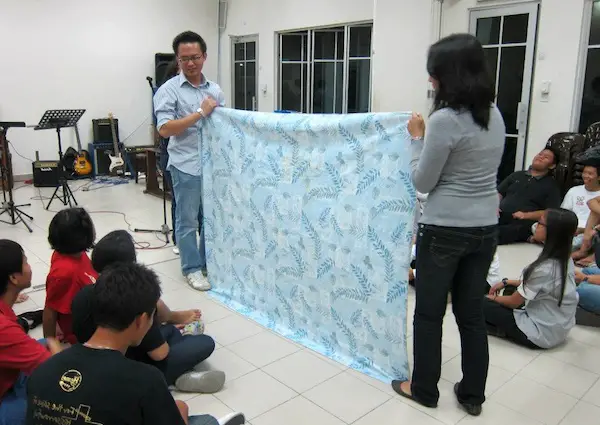
    The Blanket Game is a funny icebreaker to get to know other folks in the room.  A large blanket is held up between two groups, and one player from each team stands behind the blanket.  The goal of the game is to be the first to identify the other person behind the blanket.

    Materials required: One very large blanket (or curtain).

    This game works for small, medium, and large groups, although teams of 10 people probably work best.  For extremely large groups, pick about 20 volunteers to go to the front of the room to play.

    Setup for the Blanket Game

    There is not much setup involved for this activity.  Form two large teams, preferably about 5-10 people per team.  Have each team go to the front of the room.  Have two volunteers hold a blanket or curtain open between the two groups, so that each group cannot see behind the blanket.  If players do not know each other well, quickly have each player introduce their name to the room.

    Playing the Blanket Game

    blanket-game

    For each turn, each team chooses a volunteer to stand (or sit) behind the blanket.  The facilitator will count “1, 2, 3” and then drop the blanket.  The first player to correctly identify the name of the other player wins the round, earning one point.

    Repeat until one team reaches a desired number of points (or whenever time runs out).  This activity is a good way to learn names.  Have fun!

    To get supplies for the Blanket Name Game, shop our online store.

  • Candy Introductions Activity

    Candy Introductions Activity is a get-to-know-you game that helps people learn new facts about each other in an easy way.  They select various pieces of candy from a bag, and each candy variety is associated with a fact about themselves which they will introduce to the others. This game also goes by other names, including the M&M game, Candy Confessions, the Skittles Game, the Gum Drop game, among others.

    Candy Introductions can work with any group size.  The icebreaker game works best when the group size is limited to 12, so if you have more than 12, divide the larger group and run the icebreaker within the smaller sized groups.  This icebreaker works best indoors, and is well suited for classrooms or meeting rooms.  Materials required are: candy with about five different variations (color or candy type), and an optional chalkboard/whiteboard.

    Setup for Candy Introductions

    Purchase several variety packs of candy, enough for each person to be able to have at least five pieces.  They can be any candy type, but not too many choices (limit it to around five or six different varieties).  Alternatively, you can buy gummy bears, life savers, gum drops, skittles, m&ms, or any other candy that already has a variety of colors.

    Instructions for How to Play 

    Pass around the candy and tell each participant to choose anywhere from 1 to 5 pieces of anything that they want.  Instruct them not to eat it yet, though.  After they have chosen their candy, you will tell them what each candy type/color represents.

    If there is a whiteboard or chalkboard present, write on the board the following:

    • Red – Favorite hobbies
    • Green – Favorite place on earth
    • Blue – Favorite memory
    • Yellow -Dream job
    • Orange – Wildcard (tell us anything about yourself!)

    If you don’t have the above colors, change the above to match the candy types that you have.  Each person takes turns introducing himself or herself, beginning with their name and then saying one fact for each candy type that they have.  This easy introduction game should go relatively quickly (assuming they weren’t greedy and that they didn’t take too many pieces of candy!)

  • Fabulous Flags Game

    Fabulous Flags (also known as the Personal Flags Game) is a useful icebreaker activity to help people convey what represents them or what is important to them.  Each person draws a flag that contains some symbols or objects that symbolizes who they are or what they enjoy.

    This get-to-know-you activity is best done indoors.  Any number of people can participate.  The recommended age is 7 and up.  Materials required are: several sheets of paper, pens, and colored pencils/crayons/markers.

    Instructions for Fabulous Flags Activity

    Pass out a sheet of paper, pens, and colored pencils, crayons, and/or markers to each person.  Explain the activity: “We’re now going to draw flags that represent or symbolize us.  Please design your own flag of you – include some symbols or objects that symbolize who you are or what you find enjoyable or important.”  You can show your own sample flag if you like.  For example, you could draw:

    • a guitar (representing your passion for music)
    • a tennis racket (someone who enjoys sports)
    • a country like India (representing your affiliation with a country)
    • a cross and a heart (representing Jesus and His love for the world)

    Give everyone a set amount of time to draw (e.g. 15-20 minutes or so) and then reconvene.  Ask for volunteers to share their flags and explain the meaning of what they drew.  If it is a large group, you can divide everyone into smaller groups and ask them to share their flags with each other, or you can just ask a small number of volunteers to share.

    Variations

    After everyone has finished sharing the individual flags, as a big group you can ask everyone to brainstorm ideas on what to draw for a large class-wide flag.  Proceed to delegate individuals to draw certain parts of the class-wide flag.  Alternatively, you can collect the individual flags and paste them onto a board to create a “quilt” of individual flags, representing unity.

    (credits: thanks Eunice!)

  • Line Up Game

    Line Up! is a fun icebreaker that can be useful for camps, workplace bonding, or other large group events.  Work together as a team to arrange yourselves in a line based on a quality you have that is not obviously apparent. Examples of qualities to arrange to are alphabetically by middle name, chronologically according to birth date, or house number. Younger children could try something easier, such as arranging by height, because they may not all be able to recite the months of the year. This icebreaker starts as chaos, and ends with order as all participants work together to discover the facts they need and arrange themselves accordingly.

    Line Up works best in a large open space where participants can move around freely. This is an icebreaker that is ideal for very large groups because the leadership required scales appropriately with the number of players.  Smaller groups can still use this icebreaker, but the game is not as difficult with under 10 participants. Line Up is an engaging activity that can help group facilitators pinpoint natural leaders that emerge as the game is played, although every participant is an important part of the game.

    Materials

    To play the Line Up icebreaker, you will need:

    • A large open space for participants to move around
    • A list of qualities for the players to line up according to

    How To Play

    1. Call the group to order. Explain the rules of the game and explain the quality that they will line up according to. For example, line up in the order of your birthdays, with January 1 being the furthest to the left and December 31 being the furthest to the right.
    2. Do not help the group or give them hints as to how to organize themselves. Participants may use any objects available in the room to help them if they request them.
    3. When the group believes that the line up is correct, they will start at one end and call off their birthdays. Down the line, every participant will name off their date. The game is won if the line is correct.
    4. If the line is incorrect, give the players another quality to line up to and allow them to try again.

    Tips and Notes

    The tricky part of this game is getting a group of people who don’t know each other to establish leadership. If no one steps forward and starts to make leadership decisions, it will be very difficult for the players to line up. If too many people step forward with opposing leadership strategies, it will be difficult to find cohesion as each leader struggles to get buy in from the rest of the group.

    Line Up works particularly well with groups of people who don’t know each other. In a group that is more familiar with one another, it won’t take long for them to decide the leaders because they have previous experience with each other’s leadership skills.