Category: Party Games

These activities and games are useful for all kinds of parties. They are memorable, hilarious, entertaining, interesting… you name it. They are definitely not boring!

  • Telephone Pictionary Game

    Telephone Pictionary is a hilarious blend between the telephone game and the dictionary drawing game. Phrases need to be drawn, and other players try to draw them. As the books continue to be passed along the line, the message starts to get lost! There will be guaranteed laughs as everyone tries to guess and draw in the booklets.

    The game is a party game / stationary game. There is a bit of setup required, but no special materials are required to play, besides a lot of standard 8.5″ x 11″ paper and pens. You can also use larger paper if you wish, but this is not especially required.

    Instructions for Telephone Pictionary 

    Setup: Prepare the picture booklets by giving each player a stack of X sheets of paper, where “X” is equal to the number of players who are playing the game. Think of each stack as a “flip book” for each player. Cut each stack of paper down the middle and then fold them in half.  Staple the books if you like. Make sure each player has their own book.

    Have all players sit in a circle. Give each player their own blank picture booklet and a pen.

    1.  On the first page, have each person write down a funny or interesting phrase. This phrase can depict a scene, or perhaps a quote or song lyric, or basically any phrase that might be interesting to draw. Some examples can include (feel free to be creative with these):

    • Elvis playing basketball
    • A cow in the desert
    • Ice, Ice Baby
    • Chicken dance
    • Hot dog eating contest
    • Hitting a home run
    • Crying over spilled milk
    • Who let the dogs out
    • The dog ate my homework
    • It’s raining cats and dogs
    • Dance party

    2.  Next, everyone should pass their booklet clockwise to the person on their right. This person read the phrase that was written, turn to the next blank page, and then draw a picture of their interpretation of what they read.

    Instruct everyone to pass their booklet clockwise to the next player, making sure that their drawing is open and visible. The next person will look only at most recently drawn picture, turn to the next page, and write a phrase that tries to interpret the image that they saw. Then, everyone passes their booklets clockwise to the next player.

    3. This player sees a phrase, turns the page, and draws an image based upon this new phrase. He or she then passes this book to the next player.

    This pattern of writing phrases, then drawing pictures, then writing phrases, then drawing pictures continues until the booklets return to their original owner.

    The game ends, and each player shows all the other players their hilarious picture and phrase books and how they evolve over time.

    You can order supplies for Telephone Charades at our online store.
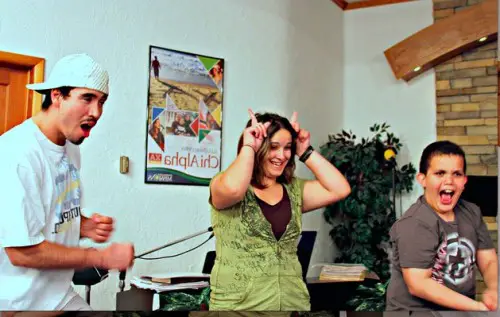
  • Screaming Viking Game

    Screaming Viking Game

    Screaming Viking is a stationary/active/party game that is highly interactive and silly.  Players must correctly act out interesting things such as a “screaming viking,” a “chia pet,” “power rangers,” and other funny things.

    This game is good for children age 9 and up.  It’s an excellent game for parties and families.  The ideal number of players is about 12-15, making it a good medium and large group game.  No special materials are required to play.   You can play indoors or somewhere like a park.

    Screaming Viking

    Setup

    There is no special setup required for this game.  Have everyone sit in a large circle, with each person facing the middle.  The facilitator should teach everyone all the various motions for how to play.  More details will be given below.

    Instructions for Playing the Game

    The basic idea behind this game is simple: one person is in the middle and tries to get someone on the outside (seated within the circle) to make a mistake.  If a person makes a mistake, he or she becomes the new person in the middle.

    To get someone “out,” the person in the middle points to one person who is sitting on the outside and commands the action.  Typically, three people must then proceed to do a funny motion and make silly noises: the person who was pointed to, and the two people on the left and right, respectively.  The three people have ten seconds to do the action properly without making any mistakes.

    There are various actions that can be done.

    • the “Screaming Viking”: the person in the middle is the main viking, who forms two horns with their fingers on their forehead and screams loudly; the person to the left and right of that person must also make a fast rowing motion with their arms.
    • “Smurfs”: three people interlock their arms and sing the smurf song, “Laaa, la, la-la, la-la….”
    • “Chia Pet”:  One person in the middle is the plant, and the people to the left and right form the pot.  All three of them must sing loudly, “Ch-ch-ch-chia…”
    • “Jello”: the person selected in the middle must wobble like gelatin (jello), while the other two people form a bowl with their arms.

    The following video demonstrates how this game works:

    http://www.youtube.com/watch?v=ejV9BzjxZiY

    If a mistake is made by any of the three people (the person selected and the people to the left and right of that person) within ten seconds, that person must go into the middle to be “it.”

    Have fun!


  • Truth or Dare Game

    Truth or Dare is a classic party game that can lead to some memorable fun.  A player chooses to answer a question truthfully or  to do a crazy dare in front of all the other players.

    Truth or Dare works best with medium sized groups.  Not many materials are required, although it can be helpful to have various household items laying around, such as toothpaste, interesting foods, etc.  This party game is often played at camp, during slumber parties, or simply when hanging out.

    Setup for Truth or Date

    There is no setup required for this party game, though it can be helpful to come prepared with some ideas in case people need help coming up with questions or dares.

    Instructions for How to Play Truth or Dare

    Each player takes a turn asking another player, “Truth or Dare?”  The player who is asked must choose to do a “truth” or a “dare.”  A truth is to answer a question truthfully, and a dare is to do something silly or crazy.  For example:

    Sample Truth Questions:

    • What is the craziest thing you have ever done?
    • What is your most embarrassing moment?
    • What is the grossest thing you’ve ever eaten?
    • If you had to marry someone in this room, who would it be?
    • What is the funniest thing that has ever happened to you?
    • What is is the most important thing you look for when dating?
    • If you had to live with only one object what would it be?
    • What is the most attractive thing in a man/woman?

    Sample Dare Questions:

    • I dare you to prank call another person we know.
    • I dare you to eat 5 packets of ketchup.
    • I dare you to put toothpaste all over your face.
    • I dare you to dance and spell your name with your butt.
    • I dare you to smell someone’s bad breath for 2 minutes.
    • I dare you to put your hand into the toilet bowl.
    • I dare you to brush another person’s teeth with your toothbrush.

    Once a person is given a Truth or a Dare request, he or she can agree to do it, or he or she can switch to the other Truth or Dare.  Be creative!

    Note: This game can be hilarious but be sure to stay safe and not force someone to do something they do not want to do.  Icebreakers.ws does not accept any responsibility for dangerous or non-law abiding behavior!


  • Assa Party Game

    Assa (or Asa) is a Korean rhythm game that follows a pattern of saying “Assa [insert name]” and going back and forth between people, calling their sign/name.  There are many similar rhythm games that follow this kind of pattern as well.

    Setup for the Assa Party Game

    Everyone needs to prepare a two-syllable name (or something that can be said within two beats) and associated hand motion.  For example, a person’s call name could be “Su-per-man” or “Fly-ing Dra-gon” or just about anything, and their hand motion can be something that depicts their name (e.g. raising the right arm up like a flying superhero for Superman).  Each person needs a unique name and hand motion.  Before beginning the game, have everyone demonstrate their name and hand motion for the other players to learn.

    Playing Assa

    Like many rhythm games, the game follows a 4-beat count (1, 2, 3, 4, 1, 2, 3, 4, etc.).  On the 1 beat, everyone pats their legs, on the 2 beat, everyone claps their hands, on the 3 beat, everyone does a thumbs up with their left hand, and on the 4 beat, everyone does a thumbs up with their right hand.  The speed of the count can gradually get faster during the game.  One person (usually the loser of the previous round) begins the new round by setting the tempo (speed) of the 4-beat count.  Players must first say and do their name and motion, and then “pass” the motion to another player by saying their name and doing their hand motion.  This must be done correctly with perfect rhythm.   This process continues until someone makes a mistake.

    For example, let’s say there are 5 players playing the game:

    • Adam (who chooses the name “Flying Tiger” and a hand motion of a tiger paw clawing)
    • Bob (who chooses the name “Awesome Dancer” and a hand motion of doing a simple disco dance move)
    • Cathy (who chooses the name “I love pizza” and a hand motion of eating a pizza slice)
    • David (who chooses the name “Elephant” and a hand motion of  moving arms like an elephant trunk)
    • Evette (who chooses the name “Crazy Ninja” and a hand motion of a ninja stance)

    To begin, choose any player to start the round.  Everyone does the four beat motion (pat, clap, thumb, thumb) together and says the word “Aaaa…ssa” each time.  Bob begins the round by saying “Aaaa….ssa, Awe-some Dan-cer” (which fills up the four beat count).  The next four beats, Bob says, “Aaaa…sa, [name of another player].”  Thus, he can say, “Aaaa…sa, I-love-pizza.”  This passes the sign over to Cathy, who is “I-love-pizza.”

    Cathy must first do her sign (says “I-love-pizza” while doing her eating motion) and she he can pass the motion to any other player.

    A typical round may sound and look like this:

    All players: “Aaaa…saaa…”
    Bob: “Awe-some-dan-cer.” (first says and does his own sign)
    All players: “Aaaa…saaa..”
    Bob: “I-love-pizza” (calls out Cathy’s sign and does the eating motion)
    All players: “Aaaa…saaa..”
    Cathy: “I-love-pizza.” (says and does her own sign first)
    All players: “Aaaa…saaa..”
    Cathy: “Cray-zee-nin-ja..” (calls out Evette’s sign and the ninja motion)
    All players: “Aaaa…saaa..”
    Evette: “Cray-zee-nin-ja..” (says and does her own sign first)
    All players: “Aaaa…saaa..”
    Evette: [chooses any other player and their hand motion]

    This process keeps going until someone makes a mistake (wrong hand motion, missed timing, etc.).  The person who began the round can also increase speed if he or she likes. When a person makes a mistake, the round ends and that person begins the next round.


  • 3 Icebreaker Games That Use Drink Cans

    1. Tipsy

    Here’s a cool party trick: if you leave just the right amount of liquid in a tin can, you can balance that can diagonally, on its edge. We’re use that fact to play a quick relay race, one part drinking game and one part balancing act.

    You will need

    One unopened 330 ml drink can for each player.
    Tables or other surface in reach of all players. This is so they have somewhere to balance their drink.

    Set-Up

    1. Split the room into two teams.
    2. Have each team arranged into a rough line, so they know what order they will play in.
    3. Give all players an unopened drink.
    4. For both teams tell the players at one end of the line that they will be the starting players.

    Rules

    The starting players open their can, drink approximately three quarters of the contents, and then attempt to balance the can on it’s edge, as quickly as they can.

    As soon as a player has successfully balanced their can, the next player in their team can proceed to open their own can and attempt the challenge. This makes this game into a sort of relay race.

    The first team to get from the start of their line to the end, with the last player having successfully balanced their can wins!

    Now that you’ve got lot’s of empty cans, we can use them for the following games!:

    2. Sliding Towers

    Do you think you could slide an empty can across a table… using only your head? Race others for the title of fastest moving face.

    You will need

    • Six empty cans per player.
      Your noggin.
      An empty table.

    Set-up

    Place an empty can near the corner of the table. If two people play simultaneously, also put a can in the opposite corner. Each player will start in one of these corners.
    Nearby, but out of the way, place the other cans so you have stacks of two and stacks of three.

    Rules

    Each player must push the single can from their end of the table to the other end using only their head and face. They cannot touch the can with their hands, shoulders neck etc. or they must take the can back to the starting position and try again.

    When a player has successfully pushed their can to end of the table, they immediately pick up a stack of two cans, put them in their starting corner, and go again with the larger stack.

    After the stack of two, players progress onto the stack of three. If at any time the stack falls over, it is immediately moved back to the starting position and the player can try again.

    This game is a race! The first player to get the third stack of cans to the end of the table wins.

    3. Candelier

    Become an architect of dangerous structures in this game, where you build a large, structurally unsound inverse pyramid out of cans and paper plates.

    You will need

    • 15 Empty Cans Per player
      5 Paper Plates per player

    (If you don’t have enough cans to play with multiple players at the same time, do this game one player at a time, and time the results. The fastest player wins)

    Set-up

    Put the cans and paper plates in reach of the players.

    Rules

    • The challenge is to build the following structure:
      One can as the foundation.
      A paper plate on top of each level of cans.
      One extra can per level of top of the plates.
      Until you end with five cans on the top level, and a final plate on top.
      This creates a sort of wonky pyramid shape, with increasing numbers of cans alternating with paper plates.

    The structure may topple, but the players can always continue on from whatever is left. The first player to finish their “candelier” wins!

  • Tilt A Cup Game

    Build and hold onto an upright swinging tower of cups and balls. As the game progresses, this tower will become increasingly unwieldy, swinging unpredictably. You’ll have to use a steady hand to keep control of the tower.  Tilt that cup!  Catch the bouncing ping pong balls to win.

    This games uses elements of games like Moving On Up and Bouncer. You can play it as a solitaire challenge, as a competitive race, or in teams.

    You will need

    • 8 plastic cups per player
    • 8 ping pong balls per player

    Set up

    For each player:

    1. Put all cups together, one inside another, to create a compressed stack.
    2. The player takes hold of the stack of cups from the bottom.
    3. Put the 8 ping pong balls within easy reach.

    Rules

    Players create a tower of cups and balls by the following process:

    • They first bounce a ping pong ball on the ground, then catch that ping pong ball in their stack of cups.
    • When the ball is caught — the top cup in a stack now has a ping pong ball in it — the player takes the cup from the bottom of the stack and places it at the top. The new top cup is now sitting on a ping pong ball and has some freedom to move around.
    • Repeat this process. Bounce another ping pong ball and catch it in the top cup of the stack. Then move the bottom cup the top, adding to an increasingly wobbly tower of alternating cups and ping pong balls.

    Once a player has caught all ping pong balls, creating a tower where every cup is separated by a ping pong ball, with one final ping pong ball in the top cup, they have finished!

    This is a great game for challenging your coordination. You not only have to bound the ball with one hand and catch it using the cups in the other, but the top cup will get increasingly further away from the hand that it trying to keep it under control. If you move the tower of cups around too quickly, or hold it at the wrong angle, it might fall apart completely, forcing you to start again.

    Variants

    To play this as a race, simply give every player a stack and their own ping pong balls. The first player to finish the challenge wins!

    The team variant has one player taking control of the stack of cups and another starting with all the ping pong balls. The player with the balls will be standing several feet away and throwing the balls to the player holding the cups. All other rules are the same.

  • Psychiatrist Game

    Confuse the designated psychiatrist by acting like other people in the group.  The psychiatrist must guess who is who and why!

    This game works best for ages 13+.  It works great with medium to large sized groups of 6+ people.  Nothing is needed except a timer or stopwatch.  Indoors is the ideal setting.

    How to set up the Psychiatrist Game

    There is no required setup.  Players should be seated in a circle.  The “psychiatrist” will be in the center of the circle.

    How to play:

    1. Organize the group so that one person is chosen as the “psychiatrist” while the others are the “patients.” The psychiatrist can be a volunteer or selected based on criteria of your choice such as who has the nearest birthday.
    2. Have the psychiatrist leave the room and wait to be fetched by one of the patients or yourself. While they’re out of the room, the patients should all talk amongst themselves and discuss who is going to act like whom. This must be based on a specific pattern that will not change. For example: Patients can decide that they will each act like the person to their immediate left. No matter if they move around or switch places with each other, the pattern will stay the same.
    3. Bring the psychiatrist back into the room and line up the patients. Start the timer for a certain amount of time (recommended to be at least 5 minutes). The psychiatrist must question people and try to figure out who is acting like whom while the patients are acting like others based on their secret pattern. If the psychiatrist asks a question and the patient answers incorrectly, the person they are pretending to be must yell out “psychiatrist!” and everyone will get up and rearrange themselves.
    4. Even when everyone is rearranged, the pattern of who is acting like whom will stay the same. The game ends when the psychiatrist guesses the pattern correctly or when the designated time runs out. When the game is over the last person to have spoken to the psychiatrist will become the new psychiatrist if you are playing for another round.

    Winning the game

    If the psychiatrist can correctly guess the pattern that the patients came up with, they will be the winners of the game. If the time runs out and the psychiatrist cannot guess the pattern within the set amount of time than they will lose the game and the patients will be the winners.  Have fun!

  • Beer Pong Party Game

    What is it?

    Beer pong: the “national sport” of frat houses and party schools.

    Who can play?

    It is traditionally played by two or four people who enjoy beer and may want to get drunk. However, this game can also be enjoyable with a non-alcoholic beverage like juice or tea, and this fun game of dexterity can be altered for players of all ages. It just requires a little good aim and dexterity! 

    What will you need?

    • 12 or 20 plastic cups
    • One or more ping pong balls
    • A table, ideally 2 to 3 meters long.
    • Optional: Liqueur

    Set-up

    1. Find a table. Beer pong was conceived as a party night-alternative to table tennis, making use of the table tennis table found in a typical college frat house. Hardcore beer pong apostles will therefore insist that a “regulation” beer pong table is the same length as a table tennis table — 2.5 meters, or 9 feet. However, you can make use of any table longer than, say, 1.5 meters. A shorter table means an easier and shorter game.
    2. Take your plastic cups and put half at each short end of the table. Arrange them in triangles, pointing to each other. With six cups this means, on each side of the table, a row of three cups along the table’s short end; two cups in front of, and touching, those; and one cup again in front of those, similar to bowling pins.
    3. Fill all cups about 3cm deep with the alcohol of your choice. Or, for a alcohol-free version, put water or another beverage in the cups instead. Even some players wanting to drink alcohol will put water in the cups, and drink from a separate source, for hygiene reasons — the choice is yours.

    We will go over the simplest version of the game, with two players. Both players stand at their end of the table, behind their triangle of cups. Each player takes a ping pong ball. You are ready to play.

    Decide who starts

    The time honored method to determine a start player is as follows. Each player looks one another in the eye over the table. Eye contact cannot be broken. Simultaneously, the players throw their ping pong ball towards the opposite side of the table. If both players get the ball in a cup, or if both players miss the cups, go again until only one player makes a cup. That player goes first. 

    Basic Rules

    The basic play of this game is very simple:

    Players will take it in turns to attempt to throw their ping pong ball into one of their opponents cups. If successful, their opponent will take that cup, drink the contents (if playing with liqueur), and remove the cup from the table.

    The player who successfully removes all of their opponents cups in this way, wins!

    Further Rules

    Throws should be made so that the player’s elbow stays behind the edge of the table.

    If playing in teams of two, each teammate will get one throw each before play is passed on to other team.

    If both teammates make cups on their turn, they are given a bonus throw each before play is passed to the other team.

    When the last cup is removed from the table, the player on the losing side is usually allowed a rebuttal. This means they are allowed to keeping shooting at their opponents remaining cups as long as they don’t miss a shot. If they miss, the game is lost. If they manage to make all of their opponents remaining cups without missing, the game will proceed into sudden death. One to three cups are added to each side of the table. Starting with the player who would have been the winner before the rebuttal, players take turns to clear these final cups to decide a winner.

    House Rules

    Beer pong can be, and usually is, played additional house rules. The number of common variations is vast, but almost all players agree that whatever the house rules are at the establishment played at, visitors must abide to.

  • Picture Whispers Game

    The Picture Whispers game is sort of like Pictionary mixed with the Telephone Game. Picture Whispers actually has some advantages over Pictionary. First, all players get to draw at the same time, and then get to guess at the same time, in phases, which means more game for everyone involved. Second, the game concludes with each player revealing sequentially all stage of drawings and guesses in their notepad, sharing with the group a short, absurd story of misunderstanding, non-sequitur, and debatable artistic merit. This reveal is similar in effect to — and has all the hilarity of — popular group storytelling game Consequences, or this collaborative drawing game.

    Play Picture Whispers with at least four players, and up to as many as you like, though as the game gets longer for every additional person in the chain, so if you have many more than ten it may be best to end the game after a certain number of passes (say, ten) rather than play all the way to the end of the circle. You could also split a large group into two smaller circles.

    Set-up:

    • All players sit in a circle, or around a table.
    • All players are given:
      • A small notebook or several small sheets of paper
      • A writing utensil.
      • Optional: Some item to be used as a bookmark, to mark which the current page is in case the notepad is closed, would also be useful.

    Rules:

    Each player will choose a word or phrase to write on the first page of their notebook. This could be an object, a person, a place, a concept, the title of a book or movie, or pretty much anything. Players are free to write something as sober, silly or lewd as they want — paying all respect to the company they are in, of course. Remember that some words are harder to express in pictures that others.

    Each player writes that word on the first page of their notebook, and passes their notebook to the player on their left. Be sure that nobody but the player on your left sees your notebook. Also be sure that nobody looks back through the notebook to see what was written or drawn by previous players.

    Now each player turns to the next page of their notebook, and draws an interpretation of the word they were passed. If the word on the first page of the notebook was “fairy”, you should now turn the page and draw a fairy, as best you can.

    Each player passes their notebook to the left again, looks at the drawing on the notebook they have just been passed from their right, and guesses what the word that inspired that drawing might be. Hopefully, the player who has just been passed a picture of a fairy writes “fairy”… but maybe that picture looks more like an “angel”, or “Tinkerbell”, or “Doctor Octopus”.

    Play proceeds in this manner, with every player alternately drawing a picture based on a work, or guessing a word based on a picture, until each notebook is passed back to its original owner (ie. the player that wrote the word on the first page).

    Now, in turn, each player reveals to the rest of the table, from the first page with the original word to the last used page, the contents of their notebook.

  • Telephone Charades

    Telephone Charades (also known as Charades Down the Line) is a hilarious icebreaker in which a person acts out a charade only for the next person in the line, who in turn acts out for the next person.  The last person standing in line attempts to guess what the original clue was.

    This is in active icebreaker that works best with a group of five or six people.  It can also be implemented for larger groups by taking five or six volunteers per round.   This game is best played indoors.  No special materials are required other than sheets of paper with the clues written on them.  Telephone Charades is for people age 10 and up.

    Setup for Telephone Charades

    Telephone Charades or “Charades Down the Line” is an active icebreaker that combines charades with the “telephone down the line” game.   To prepare for the game, write a list of humorous actions to be acted out.  Some examples are:

    • a pantomime
    • a nerd’s first date
    • a cat bathing itself
    • going skydiving
    • fishing and catching a huge fish

    Instructions for How to Play

    Choose five or six people (or ask for volunteers) and ask them to line up in a row, facing the left side of the room.  Ask the first person to turn around to see the first clue to be acted out.  Reveal the clue to the person, and display the clue to the audience as well.

    The first person turns around and taps the next person in line on the shoulder.  He or she then acts out the clue using classic charades rules (no talking or noises permitted).  The second person then taps the third person and acts out his or her understanding of what was acted out.  This process continues until it reaches the last person in line, who must guess what the action is.

    This game is funny because the acting tends to warp and get distorted based upon each person’s interpretation of what is going on.

    Variation

    A good variation to try is to have two teams line up and act out the same clue simultaneously.  The teams that guess the clue correctly (or most correctly) wins the round.