Category: Large Group

Large group icebreakers. Is your group between 10-30 people? The following games below should work great. Try them out and see for yourself!

  • Identity Circles

    Identity Circles

    Identity Circles / Value Circles

    Identity Circles (also known as Identity Cards or Value Circles) is a deeper get-to-know-you game, during which you will have an opportunity to discuss with many friends the values that make up your identity and how you prioritize them in your life. For this activity, you will be paired up with several different people, the number depending on how many people are in your group.

    The activity works best in even numbers, as pairing requires. To begin, divide your group in half and create two concentric circles (one inner circle and one outer circle). The people in the outer circle should face inside, and the people in the inner circle should face outside. Each inner circle person will pair up with an outer circle person. You can stand, sit on the floor, or use chairs for this activity; whatever is most convenient.  This game works best indoors.

    Setup for Identity Circles/Value Circles

    Purchase several index cards, enough for each participant to have ten index cards (for example, if you have sixteen players, you need at least 160 cards). Also purchase pens so that each participant has one to use.

    Instructions for How to Play

    Hand out the index cards and pens to each participant. Ask the participants to think about their values and what makes up their identity. Instruct them to write one value on each index card. They should have written down 10 values in total. Some examples of categories that can be useful for identifying values:

    • Race (e.g. Hispanic, Asian, Black, Caucasian, etc.)
    • Religion (e.g. Muslim, Christian, Athiest, etc.)
    • Occupation (e.g. Engineer, Artist, Student, Teacher, Doctor, unemployed, etc.)
    • Family (e.g. sister, brother, mother, father, daughter, son, etc.)
    • Traits (e.g. athletic, musical, artistic, analytical, creative, funny, etc.)
    • Activities (e.g. sports, cooking, comic books, making movies, etc.)
    • Health (e.g. healthy, immobile, mobile, depressed, diabetic, etc.)
    • Socio-economic (e.g. wealthy, middle-class, financially struggling, etc.)

    Once everyone has their values written down, have the participants share with their first partner why they chose to write down the values they did. After sharing for 5-7 minutes, ask all participants to rip up one of their cards. This part of the activity gives participants an opportunity to reflect on how they prioritize their values. Ripping up the card should help the participant imagine living without that part of their identity.   After the participants rip up one card, the outer circle will rotate one partner to the right. Everyone should have a new partner now. Have the new pairs discuss why they ripped up the card they ripped up.

    Continue this process until all participants are each left with one card — their most important value.

    Optional instructions: Have each person create values cards and try to order them from most important to least important.  Have each person share these values with each other and explain each one, without destroying the cards.

    This is a very easy, low-maintenance group activity that requires little preparation and can work for as small as 8 people to as large as 50 people. This activity is also good to help encourage people to share deeply with others with whom they would not otherwise share.
  • Two Truths and a Lie

    Two Truths and a Lie is a classic get-to-know-you type icebreaker game. Players tell two truths and one lie about themselves (in any order). The object of the game is for everyone else to determine which statement is actually the false one. Interesting variations of this game are provided below.

    This game is a get-to-know-you icebreaker game.  Recommended group size is: small, medium, or large.  Works best with 6-10 people.  Any indoor setting will work.  No special materials are needed, although pencil and paper is optional.  For all ages.

    Instructions for Two Truths and a Lie

    Ask all players to arrange themselves in a circle. Instruct each player to think of three statements about themselves. Two must be true statements, and one must be false.  The more unique or interesting the statement, the better!  Thus, it’s recommended to avoid common statements like “I like ice cream,” as most people could say this and it would not be as interesting as something much more unusual like “I enjoy eating bugs.”

    To play a round, each person shares the three statements (in any order) to the group. The goal of the icebreaker game is to determine which statement is false. The group votes on which one they feel is a lie, and at the end of each round, the person reveals which one was the lie.

    Variations to Try

    “Two Truths and a Dream Wish.”  An interesting variation of Two Truths and a Lie is “Two Truths and a Dream Wish.” Instead of telling a lie, a person says a wish — that is, something that is not true, yet something that the person wishes to be true. For example, someone that has never been to Europe might say: “I often travel to Europe for vacation,” or someone who wants to be a successful fashion designer might say: “I am a successful fashion designer in Paris” (not yet true, but something they dream to be true).  This interesting spin on the icebreaker can often lead to unexpected, fascinating results, as people often share touching wishes about themselves.  It’s a deeper version of the game that can lead to a better understanding of goals and wishes.

  • Never Have I Ever

    Never Have I Ever is an icebreaker game that helps people get to know each other better.  Everyone sits in a circle and take turns telling the others about some kind of experience they have never done.  Each player starts with ten fingers showing.  Each time someone says something that you’ve already done, you drop a finger. The goal is to be the last player remaining.

    This get-to-know-you game can be played indoors or outdoors.  The recommended number of people for this game is ten to fifteen, but all group sizes can play by dividing into appropriate sized groups.  Recommended age is 8 and up.  No special materials are required.

    Instructions for Never Have I Ever

    Instruct everyone to sit in a circle.  If you have an extremely large group, tell people to form smaller circles of about ten to fifteen people; this also works.  To start each round, each player holds out all ten fingers and places them on the floor.  Go around the circle and one at a time, each person announces something that they have never done, beginning the sentence with the phrase “Never have I ever…”  For example, a person could say, “Never have I ever been to Europe.”  For each statement that is said, all the other players drop a finger if they have done that statement.  So, if three other people have been to Europe before, those three people must put down a finger, leaving them with nine fingers.  The goal is to stay in the game the longest (to be the last person with fingers remaining).  To win, it’s a good strategy to say statements that most people have done, but you haven’t.

    Playing this game, along with the benefit of getting to know each others’ experiences better, can be very humorous (e.g. saying silly statements such as, “Never have I ever skipped a class in school” or “Never have I ever soiled my pants.”)  Have fun!

  • Group Juggling

    Group Juggling

    Group Juggling is a great, high-energy active icebreaker activity that helps participants learn the names of the other people in the group.  It works best when it is played in groups of about 15-20 people.  If you have more than this number of players, you can divide into smaller groups.  This game can also serve as a teambuilding activity if people do not know each other well.

    Setup for the Group Juggling Activity 

    This game is best played outside in a grassy area, or in a large, open space indoors. You will need several soft balls/tennis balls or other soft fun objects, like rubber chickens and stuffed animals. Dog toys (preferably unused) make great choices too, as they usually come with great sound effects. Bowling balls are not recommended.

    Playing the Group Juggling Activity

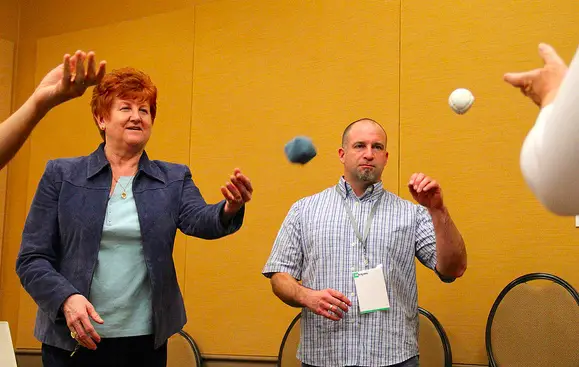
    Ask the group to form a large circle, with everyone facing the center. Start by tossing the ball across the circle to another person. As you toss, say the name of the person you to whom you are tossing. This lets them know the ball is coming to them and lets everyone hear their name. Once that person catches (or retrieves) the ball, they pick someone else, shout their name and toss them the ball. Play continues with the one ball until it makes it to everyone in the group. Once someone has received the ball, they cannot get it again. Last person in the group throws it back to the group leader. Practice the pattern a few times, always tossing to and receiving from the same person in the group. Once your group has the pattern down, start adding additional balls/objects, this is where the mayhem really begins. Keep going, try to get at least five objects going at once. Feel free to try again with a new pattern and mix it up.

    This game takes about 10 minutes in a group of 20-30 people. If you have more than 30 players, consider dividing into two circles to keep the throws within easy catch and toss range.

    If having too many objects makes the game too chaotic for your group, you may also reduce down to one ball.

  • Who Am I

    Who Am I? is a guessing game where you use the traits and characteristics of famous, historical, or company figures to break the ice with each other. Any sized group can play — you are only limited by your own imagination! Materials required are sticky nametags and a marker.  Self-adhesive white Avery labels work great.  This game works well for medium to extra large sized groups.

    Setup for the Who Am I Game

    Before your group arrives, prepare sticky nametags with the names of famous people (or any other people that EVERYONE in the group will know).  For example, you can write:

    SUPERMAN
    INDIANA JONES
    HARRY POTTER
    BATMAN
    PRESIDENT OF THE UNITED STATES
    BRITNEY SPEARS
    MICKEY MOUSE

    And so on.  If you like, you could also stick labels on each person’s forehead instead of their back.

    Playing Who Am I?

    Place one of the nametags on the upper back of each player.  Once everyone has a nametag on their back, explain the rules to everyone: each person must try to figure out which famous person that they are, only asking “Yes” or “No” questions to gain clues about the name that is on their back.

    For example, a player can ask questions like: “Am I an athlete?” “Am I a female?” “Am I a young person?” and so on.

    Timing: This game takes about ten minutes in a group of 50, less for smaller groups, but about the same for bigger groups. This is a great way to get people talking!

  • Great Wind Blows

    Great Wind Blows (also known as the Big Wind Blows) is a good icebreaker activity that involves a bit of movement, a bit similar to Musical Chairs.  The game can help everyone break the ice and help students get to know each other a bit better.  You’ll need several chairs (one fewer than the total number of players).

    Setup for Great Wind Blows Game

    In order to begin, first arrange all the chairs to form a circle (all chairs facing inward toward the middle).  One player starts in the middle, standing up.  He or she begins the round.

    Playing Great Wind Blows

    The game is simple to play; one person in the middle starts by saying “Great wind blows for everyone who…” and then says any characteristic that is true for that person.  For example, if the person has been to Canada before, he or she can say, “Great wind blows for everyone who has been to Canada.”  All players who have been to Canada before must stand and quickly find a new seat that is more than 2 chairs away from them.  If the player is not able to find a vacant seat, he or she is the new person who is in the middle.

    Some ideas include:

    • Great wind blows for everyone who has been to more than 3 countries before.
    • Great wind blows for everyone who hates chocolate.
    • Great wind blows for everyone who loves to wear boxers.
    • Great wind blows for everyone who has gone more than 2 days without showering.
    • Great wind blows for everyone who is addicted to video games.
    • Great wind blows for everyone who loves sushi.

    Be creative and have fun!  Teachers, youth group leaders and camp counselors love this game because it gets people moving, helping to break the ice at the beginning of class or youth group, or at the start of camp.   It’s also a fun way to get to know interesting things about each other.

  • Strange Disease Diagnosis Game

    Strange Disease Diagnosis Game

    Uh oh, for some reason the patient is is acting really strange!  We’ll need to guess what illness does he or she have?  The Strange Disease Diagnosis Game (which also goes by several other names, including the Mysterious Illness Game, Doctor Game, Psychiatrist Game, or Diagnosis Game) is a fun party game that involves some acting and guessing.  It involves some improvisation and silliness.  It works in different sized groups, although smaller groups of about 5-10 people is probably best.

    Setup for the Strange Disease Diagnosis / Doctor Game / Psychiatrist Game

    This is a relatively easy acting oriented game which may be improvised or may involve some rehearsal or preparation if you so wish.  The easiest way to play this game is to have one person playing the doctor and the other people play the patients.  The doctor is asked to leave the room and the patients decide what disease, illness or syndrome they all have.  For example, the patients comes up with a strange syndrome or disease that they all think they are chickens, that they are Sarah Palin, that they are secret agents, or so on.

    Playing the Strange Disease Diagnosis / Doctor Game / Psychiatrist Game

    The doctor must figure out what is wrong.  He or she may ask any player a question, but everyone keeps track of the number of questions.  After each question, the doctor can make a guess (diagnosis) of what he or she thinks is wrong.

    Of course the patient cannot just say what their condition is; they need to give clues in their performance. A person who thinks they are a chicken will suddenly cluck without reason. If they think they’re a famous politician they might try to get them to vote for them. If they think they are being spied on they may look under the table, and so on. A doctor needs to ask questions, but need to do so in the role of a doctor.

    When the doctor has correctly guessed the name of the condition (or close enough) or alternatively has given up and the patient has revealed it the patient and the doctor should change places and it’s the other person’s turn to guess.

    If you want to play it in teams of two, one team could be doctor and patient while the other team could try to guess the syndrome. Then the teams switch places.

  • Ultimate Ninja Game

    Ultimate Ninja Game

    Ultimate Ninja is one of the fastest, most hilarious party games out there.  The primary goal to be the quickest ninja warrior by hitting another player’s hand — while dodging other player’s ninja attacks!  This activity works best with about ten people in a group.  If you have a very large group, subdivide into groups of ten.  Ensure you have plenty of space to play this game.

    Materials required:  None — just a large enough space to play!

    Setup for Ultimate Ninja

    Have all players stand in a circle, facing each other, in the middle of a room.   To begin, have everyone say together, “Ultimate Ninja!”  And then everyone can freeze in a ninja pose.  At the beginning of the game, everyone must remember their turn order.  Turns go clockwise; thus a person should remember who was before and after them.

    Playing the Game

    The goal of the Ultimate Ninja game is to be the last ninja standing.  To stay in the game, you must not let anyone hit your hand.  If someone hits your hand, you are “out” and must leave the game.  Each player takes turns.  On a player’s turn, he or she is allowed one motion: one smooth motion to attack another player, or one smooth motion to move somewhere (to jump or take a large step in any direction).

    Attacking another player

    When you attack another player, you try to hit their hand with one smooth motion.  When you attack, another player is allowed one smooth motion to try to dodge your attack, even if it is not their turn.  That is, he or she can react by moving their arm or hand away; however, he or she must hold this new pose.  If you have a successful attack (i.e., if you hit their hand successfully), that person must leave the game.

    As soon as a player takes his or her turn, the next person in order may immediately take their turn.  He or she does not have to wait.

    The last person remaining wins.  Have fun — may the best ninja survive!

  • Ships and Sailors Game

    The Ships and Sailors game is a fun way to get a group of people working together and creating bonds. It’s ideal for medium to very large groups, and because it’s an elimination game, the amount of players in each round will shrink. The game is named Ships and Sailors because players follow instructions related to the theme of being aboard a boat or in the ocean. Since there are many different commands, it’s a good idea to practice all of the moves a couple of times through before officially starting the game. This game is best played in large open spaces such as a field or basketball court, so that players can move safely about the boundaries.

    Set-Up

    • Select one person to be the “captain.” They will be in charge of calling commands throughout the game.
    • Mark the boundaries of the area as you would a boat. For example, on a basketball court Starboard would be near one basket, while Port is located on the opposite side. The sides are either lines running perpendicular to Starboard and Port.

    Practice the commands:

    • Port-North—run in the direction of the marked Port
    • Starboard-South—run in the direction of the marked Starboard
    • Seasick—run to the sides of the boat and pretend to get sick
    • Man Overboard—(2 players) one person is on their hands and knees, while the other puts their knee/foot on that players back and pretends to look overboard.
    • Shark—(1 player) lie on your stomach with an arm up to look like a shark fin.
    • Fish out of water—(1 player) lie on your back kicking your knees like a fish out of water.
    • Jellyfish friends—(2 players) partners face each other and wiggle their arms.
    • Row, row, row your boat—(3 players) 3 players sit in a line and pretend to row a boat, while singing “row, row, row your boat gently down the stream. Merrily, merrily, merrily life is what a dream.”
    • Dinnertime—(4 players) 4 players sit as if they were at a table and pretend to eat.
    • Captain on Deck—Freeze where you are, face the captain, and hold the salute position. You can’t break this position until the Captain says, “At ease.” If you follow any other command before hearing “at ease,” then you will be kicked out of the game.
    • At Ease—The only command to release players from “Captain on Deck” position.

    How to Play the Ships and Sailors Game

    • Select a captain who will call out the commands during the game.
    • Review the commands listed above.
    • At any point in the game, if someone if the last to perform the command or does the wrong command, then they will be out on the sidelines.
    • Those players who are out can help the captain spot other players to eliminate.
    • The captain will call out the commands for the players to follow.
    • Players will need to listen and react to the commands accordingly. If the command involves a partner, 3 players, or 4 players, then groups will need to form quickly to avoid being eliminated.
    • There are no set partners or groups.
    • At least one person will be eliminated in each round—sometimes more depending on the command.
    • The game is played until the last player is standing.

    Variations

    • This game can be played with smaller groups if needed.
    • The commands can be adjusted to follow a different theme or response.
    • If physical activity needs to be limited then adjust moves like shark or fish out of water to avoid lying on the ground.
    • The captain can call out commands as quickly or slowly as he or she wants. Command times can be adjusted to increase the competitiveness.

    Like this activity? Please check out our other great 100+ icebreakers!

  • 6 Challenging Party Games With Paper Cups

    1. Yank Me

    A game of steady-handed stacking and precision demolishing of paper-cup towers. Can be played solo, as a race, or in teams.

    You will need:

    • Three medium sized index cards per player. They need to be big enough to fit a paper cup on top of. If you can’t find index cards, try and find A4 paper of a similar weight that you can cut up into thirds across the width. You want fairly thick paper, at least 150gsm, or it won’t hold the cup.
    • Four paper cups per player

    Rules

    The challenge for each player is this:

    1. build a tower of upside-down cups that is four cups high, with an index card between each cup.
    2. from top card to the bottom, remove the index cards so that the cups fall onto each other in a stack.

    If you stacked the cups poorly, or you don’t pull the cards in the right way, the cups will tumble off the tower and you will have to stack them back up to their full height before you can try again.

    The first player to build and collapse their tower is the winner!

    To play this as a team race, get into teams of two and assign one person as the builder (who builds the tower) and another as the collapser (who removes the index cards). If the collapser causes cups to fall away from the tower, the builder must take over again to restack the tower to it’s full height before the collapser can try again. The first team to finish wins!


    2. Moving On Up

    A game that asks player to try to be a little ambidextrous, as they alternate hands to hastily cycle through a tall stack of cups.

    You will need:

    • Lots of plastic cups! 40 per player, in fact.
    • One cup of each 40 should be a different colour to the others. If you don’t have multiple colours of cup, you could simply colour one of the cups with marker pen.

    (To save on plastic cups, instead of having everyone play simultaneously, you could use only one stack of 40 cups and time each player when it is their turn.)

    Set Up

    For each player, stack all 40 cups with the differently colored odd-cup on the bottom. Give one stack to each player to hold at the bottom with one hand.

    Rules

    Players will take the cup from the top of the stack and move it to the bottom of the stack. With their other hand, they will now reach again to the top of the stack and move that cup to the bottom. This continues, with players alternating hands with each cup moved, and the odd-cup slowly moving up the stack.

    The winner is the first player to get the odd-cup to the top of the stack and move it back to the bottom, completing the cycle.


    3. Flip Your Lid / Cup Ballet

    Here’s a challenge with a plastic cup and a bottle that is very satisfying to pull off.

    You will need:

    • One bottle (glass or plastic) per player.
    • One plastic cup per player.

    Set up

    1. Place the bottles about 30cm away from the edge of the table.
    2. Turn the plastic cup upside down and place it over the edge of the table, so about one third of the opening hangs over the edge. Each player should have a plastic cup set up in this way facing their bottle.

    Rules

    Use your fingers to flip the plastic cup into the air towards the bottle. The first player to get their cup on top of the bottle (upside down) wins!

    You can also play in teams. Have one player hold the bottle. They will stand on the opposite side of the table. The player flipping the plastic cup will now have further to flip it, but their teammate will actively move the bottle to try to “catch” the cup. The first team to do so, wins!


    4. Pass The Water

    A relay race of passing water from cup to cup. The twist? You pass the water over your head, without looking. If your teammates get overexcited this could be a wet game.

    You will need:

    • A plastic cup for each player.
    • Water.

    Set-up

    1. Split your group in half. Arrange them into two lines, all players facing the same direction, one behind another.
    2. Give each player a cup.
    3. For the player at the front of the line, give them a cup that is filled to the brim with water.

    Rules

    Without turning, the players at the front of the lines must raise their cup over their head, then pour the water in the cup backwards, while the player behind them will (hopefully) catch as much of the water as they can.

    Repeat until the water has reached the last player in the line. The team with the most water left in the last player’s cup wins!


    5. This Blows

    Commit the air from your lungs to a balloon then skillfully wield it, like Storm from the X-Men, to topple paper cups. Or waste it as your balloon pathetically deflates.

    What you need:

    • A balloon per player.
    • 15 cups per player.

    Set-up

    1. Place the plastic cups in a line at about 15cm from the edge of the table. Each player should have their own separate line of 15 cups.
    2. Take hold of your balloon and prepare yourself.

    Rules

    Inflate the balloon, then hold the opening closed with your finger. Face the opening towards the first cup in the line on the table. Release the air from the balloon so that it pushes the cup, until the cup falls off the table. Repeat with the next cup in the line. You should be able to get several cups off the table before you have to reinflate the balloon.

    The first player to blow all 15  cups off of the table wins.

    6. Cup Stacking

    This game, that seems the simplest in the list, is in some ways the most competitive. There are even cup stacking championships. The world record for “sport stacking” is 1.33 seconds. How fast can you do it?

    What you need:

    10 cups per player. That’s it!

    Rules

    The challenge for each player is this:

    1. Build a pyramid of cups. Start with a line of four to make the base. On top of these, above the gap between the cups, place another three cups, each resting on two cups below. Repeat this with a line of two cups on top of that, and a final cup at the top.
    2. Collapse the pyramid into a single stack of cups. Instead of doing this one cup at a time, you can take the top cup and carefully work it down one side of the pyramid, collecting one cup at each level, then take that stack back up to the new top cup continue collecting cups. You can collapse a pyramid of cups very quickly this way, but don’t go so fast that you knock the whole thing down.

    The first player to collect all their cups back into one stack wins.

    Competitive cup stacking uses more complex patterns, but the challenge above is a good place to start. If you want to learn more about cup stacking, speedstacks.com/learn/ might be a good place to start.