Category: Get-to-know-you

Get-to-know-you games. These icebreakers help people get to know each other better! When people don’t know each other well, a good icebreaker can be extremely useful. These activities can quickly help people get to know each others’ names and to go deeper — how do people think? What are their interests? What are their goals and deeper desires? Try these activities for the first day of class or whenever you are in a situation where you want to get to know someone better.

  • Human Bingo (Did You Know?) Game

    Human Bingo (also known as the Autograph Game or Did You Know? Bingo) is an icebreaker that helps people learn interesting facts about each other.  People walk around the room and mingle until they find people that match the facts listed on a bingo-style sheet.

    This game is a get-to-know-you style icebreaker.  The recommended group size is: large or extra large.  The game works best with a group of about 25 people.  It can be played indoors or outdoors.  Materials required are: printed bingo sheets and pens.  Ages 12 and up.

    Setup for Human Bingo

    The objective of this game is for people to wander around the room and to obtain the signatures of people who have the facts listed on the bingo sheet.  Once a person successfully obtains a full row (5 in a row), whether horizontally, vertically, or diagonally, he or she shouts “BINGO!” and wins.

    This game requires a little bit of setup.  Prepare a 5 by 5 table, with interesting facts written inside the boxes.  These facts can include funny or bizarre things.  For example:

    • Likes anchovies
    • Has been to Hawaii
    • Speaks more than two languages
    • Has never been on a plane
    • Has more than four brothers
    • Has gone without a shower for more than three days

    Be creative!  You can mark the center square “FREE SPACE” like traditional bingo games.  After you have prepared the table, print out enough copies for the number of players you are expecting.

    Instructions for How to Play

    Pass out a sheet to each person, along with a pen.  Explain the objective of the game and the following rules: (1) each person you talk to may only sign your sheet once, and (2) to win, you must get signatures to form 5 in a row horizontally, vertically, or diagonally.  Say “Go!” and ask your participants to begin.

    Once someone shouts “Bingo!” everyone returns and the person must introduce the people who signed his or her sheet.  If desired, you can ask each person to explain their fact. This icebreaker game is fun way to get to know humorous or unique facts about people.  Enjoy!

    Download Printable Template

    Download a printable template here!
  • Identity Circles

    Identity Circles

    Identity Circles / Value Circles

    Identity Circles (also known as Identity Cards or Value Circles) is a deeper get-to-know-you game, during which you will have an opportunity to discuss with many friends the values that make up your identity and how you prioritize them in your life. For this activity, you will be paired up with several different people, the number depending on how many people are in your group.

    The activity works best in even numbers, as pairing requires. To begin, divide your group in half and create two concentric circles (one inner circle and one outer circle). The people in the outer circle should face inside, and the people in the inner circle should face outside. Each inner circle person will pair up with an outer circle person. You can stand, sit on the floor, or use chairs for this activity; whatever is most convenient.  This game works best indoors.

    Setup for Identity Circles/Value Circles

    Purchase several index cards, enough for each participant to have ten index cards (for example, if you have sixteen players, you need at least 160 cards). Also purchase pens so that each participant has one to use.

    Instructions for How to Play

    Hand out the index cards and pens to each participant. Ask the participants to think about their values and what makes up their identity. Instruct them to write one value on each index card. They should have written down 10 values in total. Some examples of categories that can be useful for identifying values:

    • Race (e.g. Hispanic, Asian, Black, Caucasian, etc.)
    • Religion (e.g. Muslim, Christian, Athiest, etc.)
    • Occupation (e.g. Engineer, Artist, Student, Teacher, Doctor, unemployed, etc.)
    • Family (e.g. sister, brother, mother, father, daughter, son, etc.)
    • Traits (e.g. athletic, musical, artistic, analytical, creative, funny, etc.)
    • Activities (e.g. sports, cooking, comic books, making movies, etc.)
    • Health (e.g. healthy, immobile, mobile, depressed, diabetic, etc.)
    • Socio-economic (e.g. wealthy, middle-class, financially struggling, etc.)

    Once everyone has their values written down, have the participants share with their first partner why they chose to write down the values they did. After sharing for 5-7 minutes, ask all participants to rip up one of their cards. This part of the activity gives participants an opportunity to reflect on how they prioritize their values. Ripping up the card should help the participant imagine living without that part of their identity.   After the participants rip up one card, the outer circle will rotate one partner to the right. Everyone should have a new partner now. Have the new pairs discuss why they ripped up the card they ripped up.

    Continue this process until all participants are each left with one card — their most important value.

    Optional instructions: Have each person create values cards and try to order them from most important to least important.  Have each person share these values with each other and explain each one, without destroying the cards.

    This is a very easy, low-maintenance group activity that requires little preparation and can work for as small as 8 people to as large as 50 people. This activity is also good to help encourage people to share deeply with others with whom they would not otherwise share.

  • Two Truths and a Lie

    Two Truths and a Lie is a classic get-to-know-you type icebreaker game. Players tell two truths and one lie about themselves (in any order). The object of the game is for everyone else to determine which statement is actually the false one. Interesting variations of this game are provided below.

    This game is a get-to-know-you icebreaker game.  Recommended group size is: small, medium, or large.  Works best with 6-10 people.  Any indoor setting will work.  No special materials are needed, although pencil and paper is optional.  For all ages.

    Instructions for Two Truths and a Lie

    Ask all players to arrange themselves in a circle. Instruct each player to think of three statements about themselves. Two must be true statements, and one must be false.  The more unique or interesting the statement, the better!  Thus, it’s recommended to avoid common statements like “I like ice cream,” as most people could say this and it would not be as interesting as something much more unusual like “I enjoy eating bugs.”

    To play a round, each person shares the three statements (in any order) to the group. The goal of the icebreaker game is to determine which statement is false. The group votes on which one they feel is a lie, and at the end of each round, the person reveals which one was the lie.

    Variations to Try

    “Two Truths and a Dream Wish.”  An interesting variation of Two Truths and a Lie is “Two Truths and a Dream Wish.” Instead of telling a lie, a person says a wish — that is, something that is not true, yet something that the person wishes to be true. For example, someone that has never been to Europe might say: “I often travel to Europe for vacation,” or someone who wants to be a successful fashion designer might say: “I am a successful fashion designer in Paris” (not yet true, but something they dream to be true).  This interesting spin on the icebreaker can often lead to unexpected, fascinating results, as people often share touching wishes about themselves.  It’s a deeper version of the game that can lead to a better understanding of goals and wishes.

  • Never Have I Ever

    Never Have I Ever is an icebreaker game that helps people get to know each other better.  Everyone sits in a circle and take turns telling the others about some kind of experience they have never done.  Each player starts with ten fingers showing.  Each time someone says something that you’ve already done, you drop a finger. The goal is to be the last player remaining.

    This get-to-know-you game can be played indoors or outdoors.  The recommended number of people for this game is ten to fifteen, but all group sizes can play by dividing into appropriate sized groups.  Recommended age is 8 and up.  No special materials are required.

    Instructions for Never Have I Ever

    Instruct everyone to sit in a circle.  If you have an extremely large group, tell people to form smaller circles of about ten to fifteen people; this also works.  To start each round, each player holds out all ten fingers and places them on the floor.  Go around the circle and one at a time, each person announces something that they have never done, beginning the sentence with the phrase “Never have I ever…”  For example, a person could say, “Never have I ever been to Europe.”  For each statement that is said, all the other players drop a finger if they have done that statement.  So, if three other people have been to Europe before, those three people must put down a finger, leaving them with nine fingers.  The goal is to stay in the game the longest (to be the last person with fingers remaining).  To win, it’s a good strategy to say statements that most people have done, but you haven’t.

    Playing this game, along with the benefit of getting to know each others’ experiences better, can be very humorous (e.g. saying silly statements such as, “Never have I ever skipped a class in school” or “Never have I ever soiled my pants.”)  Have fun!

  • Group Juggling

    Group Juggling

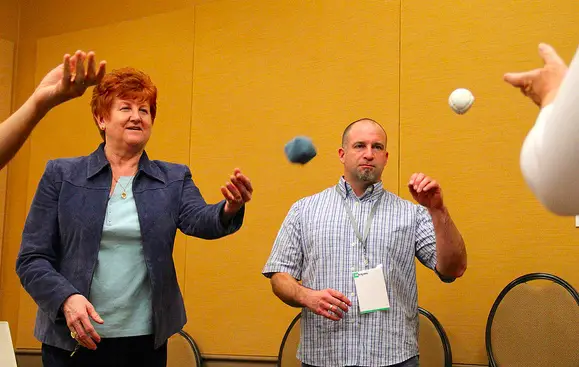
    Group Juggling is a great, high-energy active icebreaker activity that helps participants learn the names of the other people in the group.  It works best when it is played in groups of about 15-20 people.  If you have more than this number of players, you can divide into smaller groups.  This game can also serve as a teambuilding activity if people do not know each other well.

    Setup for the Group Juggling Activity 

    This game is best played outside in a grassy area, or in a large, open space indoors. You will need several soft balls/tennis balls or other soft fun objects, like rubber chickens and stuffed animals. Dog toys (preferably unused) make great choices too, as they usually come with great sound effects. Bowling balls are not recommended.

    Playing the Group Juggling Activity

    Ask the group to form a large circle, with everyone facing the center. Start by tossing the ball across the circle to another person. As you toss, say the name of the person you to whom you are tossing. This lets them know the ball is coming to them and lets everyone hear their name. Once that person catches (or retrieves) the ball, they pick someone else, shout their name and toss them the ball. Play continues with the one ball until it makes it to everyone in the group. Once someone has received the ball, they cannot get it again. Last person in the group throws it back to the group leader. Practice the pattern a few times, always tossing to and receiving from the same person in the group. Once your group has the pattern down, start adding additional balls/objects, this is where the mayhem really begins. Keep going, try to get at least five objects going at once. Feel free to try again with a new pattern and mix it up.

    This game takes about 10 minutes in a group of 20-30 people. If you have more than 30 players, consider dividing into two circles to keep the throws within easy catch and toss range.

    If having too many objects makes the game too chaotic for your group, you may also reduce down to one ball.

  • Great Wind Blows

    Great Wind Blows (also known as the Big Wind Blows) is a good icebreaker activity that involves a bit of movement, a bit similar to Musical Chairs.  The game can help everyone break the ice and help students get to know each other a bit better.  You’ll need several chairs (one fewer than the total number of players).

    Setup for Great Wind Blows Game

    In order to begin, first arrange all the chairs to form a circle (all chairs facing inward toward the middle).  One player starts in the middle, standing up.  He or she begins the round.

    Playing Great Wind Blows

    The game is simple to play; one person in the middle starts by saying “Great wind blows for everyone who…” and then says any characteristic that is true for that person.  For example, if the person has been to Canada before, he or she can say, “Great wind blows for everyone who has been to Canada.”  All players who have been to Canada before must stand and quickly find a new seat that is more than 2 chairs away from them.  If the player is not able to find a vacant seat, he or she is the new person who is in the middle.

    Some ideas include:

    • Great wind blows for everyone who has been to more than 3 countries before.
    • Great wind blows for everyone who hates chocolate.
    • Great wind blows for everyone who loves to wear boxers.
    • Great wind blows for everyone who has gone more than 2 days without showering.
    • Great wind blows for everyone who is addicted to video games.
    • Great wind blows for everyone who loves sushi.

    Be creative and have fun!  Teachers, youth group leaders and camp counselors love this game because it gets people moving, helping to break the ice at the beginning of class or youth group, or at the start of camp.   It’s also a fun way to get to know interesting things about each other.

  • Wedding Shoe Game

    The Wedding Shoe Game is a great way to create laughs and memories after the ceremony. The shoe game is ideal for a wedding because it allows the whole audience to participate, while still focusing on the newlyweds. There is no limit to the amount of players that can participate. Guests can get to know the bride and groom more through their comical shoe responses and inevitable disagreements.

    Set-Up

    Ask the tables or individuals to submit ‘who’ questions before the wedding to use.

    • The questions should focus on the couple and be easy enough to answer with a raised shoe.  For example: Who is the better dancer? Who is more likely to do the dishes? Who is more likely to make the dishes? Who said I love you first? Who is more likely to get sunburnt? Who wears the pants in the relationship?
    • Seat the newly married couple in front of or in the middle of the room, dance floor, etc.
    • Have all the guests seated around the couple, so that everyone can see/hear them.
    • The teams will be set up based on the table seating. Each table of guests will be one group that can contribute a question to ask.
    • Select one individual such as the DJ or someone from the wedding party to ask the questions.
    • The bride and groom should each take one of their shoes off to use for the game.

    How to Play the Wedding Shoe Game

    • Seat the bride and groom in the front or middle of the room.
    • Have the bride and groom seated back to back, so they can’t see each other’s responses.
    • Select someone to read off the ‘who’ questions from the guests.
    • Whenever the question applies to the person, they will raise their shoe in the air.  For example: “Who is a morning person?”   The bride might raise her shoe and not the groom.
    • There can be some disagreements when asking questions like, who is funnier? Both the bride and groom might raise their shoe in the air.

    Variations

    • This game can be played at any point during the wedding, but it is most commonly played during the reception before food is served.
    • Instead of using one person to read the questions, the bride and groom can read them off to each other.
    • Family members and friends can also ask the questions.
    • Give each table five minutes to come up with one question together during the wedding.
    • The couple can raise any object in the air—their hands, a wand, a balloon.
    • The couple can switch shoes—the bride holds a dress shoe, while the groom holds a heel.
  • Personal Artifact Game

    The Personal Artifact Game is the perfect icebreaker for those who want to stay away from the usual “who, what, where” questions that are typically asked in these sorts of activities. It requires participants to dig a little deeper than just their favorite color and bring something personal to the table!  Players are more likely to remember each other’s names from the stories behind each artifact. It encourages players to get to know each other personally and also provides future topics to discuss. Whether it’s the first day of class, camp, or on the job, the personal artifact icebreaker is sure to get discussions flowing and give each player a memorable moment associated with them.

    Set-Up

    • Note that this game requires people to plan a little bit in advance — ask each player to bring in a personal artifact from home.
    • A personal artifact can be anything that is special or who represents the individual. For example, players can bring in a stuffed teddy bear from childhood, an x-ray of a broken bone, a picture, or a locket.
    • Pair up with partners or set up seating into a half circle.

    How to Play the Personal Artifact Game

    1. Assign each a number or go alphabetically to select the order.
    2. If using a half circle, then have each person stand in front of the group. If using partners, then pair up people.
    3. Going one at a time, each person will briefly present their personal artifact to the group, including what it is and why they chose it.
    4. Depending on the amount of time, the audience can ask 2-3 questions about the artifact.

    Variations

    • Instead of having the player bring in a personal object, they can use anything they have on them. Players can pull something out of their purse, wallet, or even use their current clothing and tell about its origin.
    • Players can pass around their artifacts if they feel comfortable.
    • To make the game more interesting, you can take the items and mix them up on a table, then have players guess who each of the items belongs to and explain why.
  • Extremes Game: Where Do You Stand?

    The Extremes Game: Where Do You Stand? is a useful classroom icebreaker that helps people get to know each other’s opinions and stances a bit better.  It can be played with medium to extra large sized groups and is a good way to get everyone moving around a little bit.  The game can vary in time depending on how many questions you use; in general allow for 5-15 minutes as a good range.

    Materials required: None!

    Setup for Extremes Game: Where Do You Stand?

    In the front of the room, create an imaginary line.  All the way on the left side is one extreme, and all the way on the right side is the other extreme.  Make sure there is enough space for people to stand anywhere along this imaginary line.

    To play this game, you will ask everyone several questions.  Everyone will then respond by standing somewhere along the imaginary line according to how strong of an opinion they have on that item.  For example, if you ask people “coffee? or tea?” people will stand far along the left hand side if they strongly prefer coffee, and they will stand on the far end of the right hand side if they strongly prefer tea.  If they are neutral, they will stand in the middle.

    You can ask many kinds of questions.  For example,

    • winter or summer?
    • sweet or salty?
    • Hawaii or New York City?
    • boxers or briefs?
    • rock music or classical?
    • chocolate or strawberry?
    • Morning person or Night person?
    • would you rather be short or tall?
    • would you rather be rich or beautiful?

    Many of these questions can be very funny.  You can also ask many deep questions as well — use your imagination and have fun!

    If you don’t want to come up with your own questions, a good board game version with many questions provided is: Would You Rather? Boardgame – Classic Version, now available from Amazon.  Enjoy and have fun!

  • 3 Games of Intimate Cooperation

    1. Pucker Up

    You won’t kiss anyone in this game, but you won’t be far off. The game challenges you to carry a tennis ball between the mouths of two players. Get in sync with your partner or risk dropping the ball and ruining the mood.

    You will need

    • 3 tennis balls per team
      A glass for each team
      A bowl for each team

    Set-up

    1. Put the glass and bowl, which are your start point and endpoint respectively, on opposite sites of the room.
    2. Place the tennis balls near the glass.
    3. Arrange players into pairs. v

    Rules

    One teammate will place a tennis ball on top of the glass. This is so you have easy access to all sides of the ball. Both teammates now lower their faces to the tennis ball and place their mouths on opposite sides of the ball.

    Now that the ball is trapped between their faces, they should now be able to lift and move the ball. With ball only in contact with both player’s mouths, the teammates will transport the ball to the bowl on the other side of the room, and drop the ball in the bowl.

    Return to the other side of the room, and repeat for the other two tennis balls to finish the challenge. The team that finishes first, wins!


    Ready Spaghetti

    A similar concept to above. There’s no Lady And The Tramp spaghetti action here, but you will be holding a piece of uncooked spaghetti lengthways between two player’s mouths. They use this rigid pasta prop to transport soda cans, threading the pasta through the can’s ring pull.

    You will need

    • A strand of uncooked spaghetti per team.
    • 3 empty soda cans per player. Pull the ring pulls on all cans into a vertical position.

    Set-up

    1. Place the soda cans on one end of the room.
    2. Designate an “target area” on a surface at the other end of the room.
    3. Arrange players into pairs. The two teammates will start by standing on opposite sites of the soda cans.

    Rules

    One teammate places one end of the spaghetti in their mouths, so that it is pointing away from them. Without using any other part of their body point the spaghetti towards the can, and thread it through the ring pull. The other player now uses their mouth to hold the other end of the spaghetti.

    The team can now lift the spaghetti supported can between them. Take the can to the target area. One player now releases the spaghetti so it can be freed to use for the next can.

    Go back to the cans and repeat twice more. The first team to transport all three cans wins!


    Belly Balloon Break

    Use the power of hugging to violently burst as many balloons as possible between you and your teammate’s bellies. Don’t get too affectionate — this is squeezing is for competitive purposes!

    You will need

    1. 10 baloons for each team.

    Rules

    Arrange the players into pairs. Players must pick up a balloon, hold it between the bellies of themselves and their teammates, then remove their hands so that the balloon is supported only by belly pressure.

    Together, the teammates squeeze the balloon between them until it pops! Take another balloon and repeat the process.

    The first team to pop all ten of their balloons wins!