Author: Blahman

  • Win an iPad Contest: Party Games!

    One of our good friends, Joe, has just launched a brand new site: Party Games Guide!  We love the website so much that we want to help his website take off!  To celebrate the launch, we’re giving away a brand new iPad retina mini (up to $500 value) to a lucky winner.

    How to win it? The rules are simple — just share a link to the Party Games website on your blog or website and email us with the link to your webpage, and you’re entered for the random drawing!  It only takes a minute to enter.

    Three steps to entering the iPad Contest.  Just visit the site, share it with others, and email us!

    1. Go to Party Games Guide (http://www.PartyGames.guide/)
    2. You can use the following code if you like:
      <a href=”http://www.partygames.guide/”>Party Games</a> free party ideas guide!
    3. Email john@icebreakers.ws with a link to your website (where you placed the link).  Voila!  You’re entered in the contest.  Good luck!
  • Human Rock Paper Scissors

    Human Rock Paper Scissors is a fun, quick ice-breaker that can be used for a medium-sized group of people. Many are familiar with the classic hand game, rock-paper-scissors, each of which conquers one another depending on the combination. This game is a play on the game, but requires people to get on their feet, move, and act as a team, rather than an individual.

    This ice-breaker is especially fun because it can be tailored to many different themes and variations.

    Setup for Human Rock Paper Scissors

    As a large group, decide a full-body pose that will signify each element (e.g. Rock – each person of one group will bend down and hug their knees and curl into a ball so they look like a rock, Scissors – each person of one group will stand with legs shoulder-width apart and both arms up and hands behind the head so they look like a scissor).

    Playing Human Rock Paper Scissors 

    After the poses are decided, break participants into two groups. For each round, each group will need to do one of the poses (everyone in each group will need to do the same pose). Each group will have 5 minutes to strategize. Once all of the groups have their poses ready, a facilitator will have the two groups face each other and count down from three (e.g. three….two…one….SHOOT). On “SHOOT” each group will need to strike one of the three poses. Rock beats Scissors, Scissors beat Paper, and Paper beats Rock. You can play however times you’d like. Best out of 5 rounds is a good number for a medium sized group.

    If you want to try some different themes of this game you can try some of the following themes or make up some of your own!

    • Lord of the Rings – Hobbit, Elf, Orc (Orc beats Hobbit, Elf beats Orc, Hobbit beats Elf)
    • Schools – Stanford, Cal, USC (Stanford beats USC, Cal beats Stanford, USC beats Cal)
    • Super Heroes – Batman, Spiderman, Green Lantern (Spiderman beats Batman, Batman beats Green Lantern, Green Lantern beats Spiderman)
    • Disney Villains – Maleficent, Ursula, Jafar (Maleficent beats Ursula, Ursula beats Jafar, Jafar beats Maleficent)

    This is a very fun activity that’s quick, high-energy and requires no pre-activity prep.

  • Secret Santa Gift Exchange

    Who is your Secret Santa? The Secret Santa Gift Exchange is a fun party game that involves buying a gift for somebody — and that person has no idea who!  It’s ideal for the holidays, especially during Christmas time.

    Setup for the Secret Santa Gift Exchange

    One person needs to be the Secret Santa coordinator.  This person needs to generate a list of all the participants for this activity.  He or she will then randomize who is assigned to whom.  Make sure no one is assigned to themselves.  Once everyone is assigned their Secret Santa, the coordinator tells everyone who they have been assigned.

    Playing Secret Santa Gift Exchange

    The coordinator emails everyone with the rules and explains to everyone the time limit to buy presents.  Two or three weeks is a good amount of time.  Each person must buy a gift and secretly deliver it to their assigned person.  To deliver the gift, you can give it to a third party or find another clever way to drop off the gift.

    Alternatively, you can also be a secret santa over a longer duration of time.  For example, you can be a Secret Santa for an entire month and give secret little gifts for a long time.

    It is up to you if you want to reveal your Secret Santa identity!  It’s not required although it might be more fun to eventually have your identities revealed.

  • Wink Murder

    Wink Murder is a fun party game in a secret “killer” winks at people in the eye in order to get them eliminated.  Try to identify who the wink murderer is before he murders everyone!

    Setup for Wink Murder

    This game requires no special materials at all, making it a very convenient game to play.  It can be played both outdoors and indoors.  Also, no materials are required to be purchased.  The only step required is to get everyone together and to have them arranged in a circle.   This game works best when there are at least ten people, but no more than thirty, as the game may take too long.

    Playing Wink Murder

    Each round, you need a way to determine who is to be the “wink murderer.”  You can use a moderator who secretly picks a person while everyone’s eyes are closed, or you can deal each person a card from a deck of cards and pick a card like the Joker to represent who is the wink murderer for the round.

    Once a wink murder has been selected and everyone is ready to play, the game begins.   Everyone stands up and wanders around the room, making conversation.  Each person must make eye contact with each other.  The wink murderer must try to wink at other people.

    If a person receives a wink from the murderer, that person must “die” by falling to the ground dramatically (in a funny way, such as clutching one’s heart or gasping with loud noises).  He or she is allowed to wait a few seconds in order to make it harder to tell who the murderer is.  The dead person must leave the game and play resumes.  If a living person thinks that he or she knows who the murderer is, he or she can raise their hand and say “I accuse!”  Another person must “second” the accusation.  If there is a second, the accuser yells the name of the person they suspect is the murderer.   The accused must say “yes” (they are the murderer) or “no” (they are innocent).   If correct, the the murder has been successfully caught and the round is over (a win for the people).  If the accusation is incorrect, the accuser must leave the game as penalty.  Alternatively, the group may gain a “strike” for a wrong accusation, with the third strike being a loss for the people.  The game continues until the killer is identified or there is only one mingler left.

    An optional rule for the game is that there is no talking.
  • Identity Circles

    Identity Circles

    Identity Circles / Value Circles

    Identity Circles (also known as Identity Cards or Value Circles) is a deeper get-to-know-you game, during which you will have an opportunity to discuss with many friends the values that make up your identity and how you prioritize them in your life. For this activity, you will be paired up with several different people, the number depending on how many people are in your group.

    The activity works best in even numbers, as pairing requires. To begin, divide your group in half and create two concentric circles (one inner circle and one outer circle). The people in the outer circle should face inside, and the people in the inner circle should face outside. Each inner circle person will pair up with an outer circle person. You can stand, sit on the floor, or use chairs for this activity; whatever is most convenient.  This game works best indoors.

    Setup for Identity Circles/Value Circles

    Purchase several index cards, enough for each participant to have ten index cards (for example, if you have sixteen players, you need at least 160 cards). Also purchase pens so that each participant has one to use.

    Instructions for How to Play

    Hand out the index cards and pens to each participant. Ask the participants to think about their values and what makes up their identity. Instruct them to write one value on each index card. They should have written down 10 values in total. Some examples of categories that can be useful for identifying values:

    • Race (e.g. Hispanic, Asian, Black, Caucasian, etc.)
    • Religion (e.g. Muslim, Christian, Athiest, etc.)
    • Occupation (e.g. Engineer, Artist, Student, Teacher, Doctor, unemployed, etc.)
    • Family (e.g. sister, brother, mother, father, daughter, son, etc.)
    • Traits (e.g. athletic, musical, artistic, analytical, creative, funny, etc.)
    • Activities (e.g. sports, cooking, comic books, making movies, etc.)
    • Health (e.g. healthy, immobile, mobile, depressed, diabetic, etc.)
    • Socio-economic (e.g. wealthy, middle-class, financially struggling, etc.)

    Once everyone has their values written down, have the participants share with their first partner why they chose to write down the values they did. After sharing for 5-7 minutes, ask all participants to rip up one of their cards. This part of the activity gives participants an opportunity to reflect on how they prioritize their values. Ripping up the card should help the participant imagine living without that part of their identity.   After the participants rip up one card, the outer circle will rotate one partner to the right. Everyone should have a new partner now. Have the new pairs discuss why they ripped up the card they ripped up.

    Continue this process until all participants are each left with one card — their most important value.

    Optional instructions: Have each person create values cards and try to order them from most important to least important.  Have each person share these values with each other and explain each one, without destroying the cards.

    This is a very easy, low-maintenance group activity that requires little preparation and can work for as small as 8 people to as large as 50 people. This activity is also good to help encourage people to share deeply with others with whom they would not otherwise share.

  • Two Truths and a Lie

    Two Truths and a Lie is a classic get-to-know-you type icebreaker game. Players tell two truths and one lie about themselves (in any order). The object of the game is for everyone else to determine which statement is actually the false one. Interesting variations of this game are provided below.

    This game is a get-to-know-you icebreaker game.  Recommended group size is: small, medium, or large.  Works best with 6-10 people.  Any indoor setting will work.  No special materials are needed, although pencil and paper is optional.  For all ages.

    Instructions for Two Truths and a Lie

    Ask all players to arrange themselves in a circle. Instruct each player to think of three statements about themselves. Two must be true statements, and one must be false.  The more unique or interesting the statement, the better!  Thus, it’s recommended to avoid common statements like “I like ice cream,” as most people could say this and it would not be as interesting as something much more unusual like “I enjoy eating bugs.”

    To play a round, each person shares the three statements (in any order) to the group. The goal of the icebreaker game is to determine which statement is false. The group votes on which one they feel is a lie, and at the end of each round, the person reveals which one was the lie.

    Variations to Try

    “Two Truths and a Dream Wish.”  An interesting variation of Two Truths and a Lie is “Two Truths and a Dream Wish.” Instead of telling a lie, a person says a wish — that is, something that is not true, yet something that the person wishes to be true. For example, someone that has never been to Europe might say: “I often travel to Europe for vacation,” or someone who wants to be a successful fashion designer might say: “I am a successful fashion designer in Paris” (not yet true, but something they dream to be true).  This interesting spin on the icebreaker can often lead to unexpected, fascinating results, as people often share touching wishes about themselves.  It’s a deeper version of the game that can lead to a better understanding of goals and wishes.

  • Never Have I Ever

    Never Have I Ever is an icebreaker game that helps people get to know each other better.  Everyone sits in a circle and take turns telling the others about some kind of experience they have never done.  Each player starts with ten fingers showing.  Each time someone says something that you’ve already done, you drop a finger. The goal is to be the last player remaining.

    This get-to-know-you game can be played indoors or outdoors.  The recommended number of people for this game is ten to fifteen, but all group sizes can play by dividing into appropriate sized groups.  Recommended age is 8 and up.  No special materials are required.

    Instructions for Never Have I Ever

    Instruct everyone to sit in a circle.  If you have an extremely large group, tell people to form smaller circles of about ten to fifteen people; this also works.  To start each round, each player holds out all ten fingers and places them on the floor.  Go around the circle and one at a time, each person announces something that they have never done, beginning the sentence with the phrase “Never have I ever…”  For example, a person could say, “Never have I ever been to Europe.”  For each statement that is said, all the other players drop a finger if they have done that statement.  So, if three other people have been to Europe before, those three people must put down a finger, leaving them with nine fingers.  The goal is to stay in the game the longest (to be the last person with fingers remaining).  To win, it’s a good strategy to say statements that most people have done, but you haven’t.

    Playing this game, along with the benefit of getting to know each others’ experiences better, can be very humorous (e.g. saying silly statements such as, “Never have I ever skipped a class in school” or “Never have I ever soiled my pants.”)  Have fun!

  • Classroom Icebreakers for School!

    Classroom Icebreakers for School!

    It’s back to school time!  Are you a teacher or professor getting ready for the upcoming school year? Don’t forget that classroom icebreakers are one of the best ways to get your students to open up and be more engaged.   I’ve been teaching students of all ages for well over a decade — for me, it’s clear that icebreakers can make a huge difference!  This article will give you some of my favorite recommendations for classroom activities.

    Beginning of the School Year? Consider an introduction game.

    At the beginning of the school year, sometimes students are very shy and reluctant to speak up.  During this time, students may not know each other and may feel uncomfortable.  Some icebreakers are especially helpful for getting people to know each other better through fun introduction activities.  For example,  the Blanket Game can get students to know each others’ names and faces quickly.  The famous Two Truths and a Lie can quickly get people to discover amazing things about each other.  To build common ground, Unique and Shared can get students to discover what they have in common with others in the room.

    Sometimes the simplest icebreakers can be elegant and quick-and-easy.  Candy Introductions requires just a couple bags of candy to play.  Icebreaker Questions can break the ice with some interesting questions to get students to go beyond the superficial.  Once students start sharing about themselves in the classroom, it makes it much easier for them to feel comfortable participating in class activities.

    Getting Students to Voice Their Opinions

    One of our favorite games to get students to express where they stand on various issues is the Extremes: Where Do You Stand? game, making use of the classroom space itself in a visual way.  Four Corners is another good game that takes advantage of the corners of the room.

    Are you a classroom teacher?  We’d love to hear from you what your favorite icebreakers.  Which ones do you find to be most successful?  Let us know!

  • Group Juggling

    Group Juggling

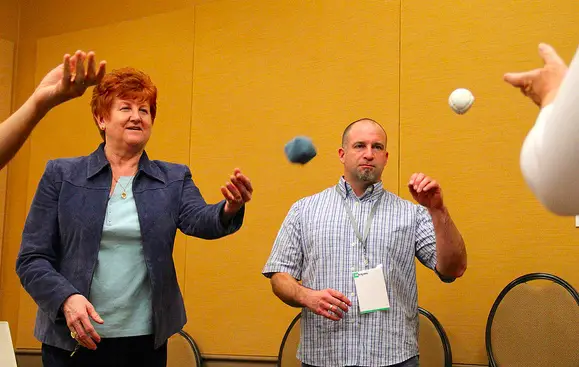
    Group Juggling is a great, high-energy active icebreaker activity that helps participants learn the names of the other people in the group.  It works best when it is played in groups of about 15-20 people.  If you have more than this number of players, you can divide into smaller groups.  This game can also serve as a teambuilding activity if people do not know each other well.

    Setup for the Group Juggling Activity 

    This game is best played outside in a grassy area, or in a large, open space indoors. You will need several soft balls/tennis balls or other soft fun objects, like rubber chickens and stuffed animals. Dog toys (preferably unused) make great choices too, as they usually come with great sound effects. Bowling balls are not recommended.

    Playing the Group Juggling Activity

    Ask the group to form a large circle, with everyone facing the center. Start by tossing the ball across the circle to another person. As you toss, say the name of the person you to whom you are tossing. This lets them know the ball is coming to them and lets everyone hear their name. Once that person catches (or retrieves) the ball, they pick someone else, shout their name and toss them the ball. Play continues with the one ball until it makes it to everyone in the group. Once someone has received the ball, they cannot get it again. Last person in the group throws it back to the group leader. Practice the pattern a few times, always tossing to and receiving from the same person in the group. Once your group has the pattern down, start adding additional balls/objects, this is where the mayhem really begins. Keep going, try to get at least five objects going at once. Feel free to try again with a new pattern and mix it up.

    This game takes about 10 minutes in a group of 20-30 people. If you have more than 30 players, consider dividing into two circles to keep the throws within easy catch and toss range.

    If having too many objects makes the game too chaotic for your group, you may also reduce down to one ball.

  • Best Icebreakers for Date Night: Part 2

    Best Icebreakers for Date Night: Part 2

    In last week’s blog post, we took a look at some of the best icebreakers for date night, which took a look at icebreaker questions to help you get to know each other better and after-date game activities to create a memorable experience.  We continue today with Part Two: Icebreaker Games for Every Situation!

    1. If you want your date to feel like you have a lot in common

    Some good conversation starters for a date include getting a sense of a person’s favorite childhood shows.  You could ask something like, “Which cartoon character do you relate to the most?” or “If you were a character on the TV show Friends, who would you be?”  Once you find out, you can enjoy laughing at their personality type.  We recommend these additional good icebreaker questions to help you understand each other more.  Remember, keep your date talking about himself or herself!  This is key to getting them to feel comfortable with you.  Don’t blab on and on about yourself.

    2. If you want your date to know interesting things you’ve done

    Good icebreakers might include Never Have I Ever, to get a sense of what crazy or interesting things a person might have done or not done.  You can quickly get a sense if someone is the adventurous type, or if they haven’t done a lot of ridiculous things!  Two Truths and a Lie can also help you get to know each other more in a fun way.  Getting to know each other in this way can quickly break the ice and help you feel closer!

    3. If you want your date to think you are funny

    There are many activities you can do for a hilarious date night.  For more adult-oriented fun, consider playing a game like Cards Against Humanity.  The more you can keep the laughs going, the more he or she will enjoy being with you.  Everyone likes being with someone with a good sense of humor!

    4. If you want your date to get to know your deep, sensitive side

    You can ask your date some questions to help them understand you and have them open up with what makes them tick.  For example, asking them: “If you had a million dollars, what would you do with it?” or “If every job paid the same amount of money, what would you do?” are great questions for getting a sense of what is important to them.

    Try these icebreaker activities on your next date and he or she won’t think of you as a boring person.  Good luck and enjoy your date night!